
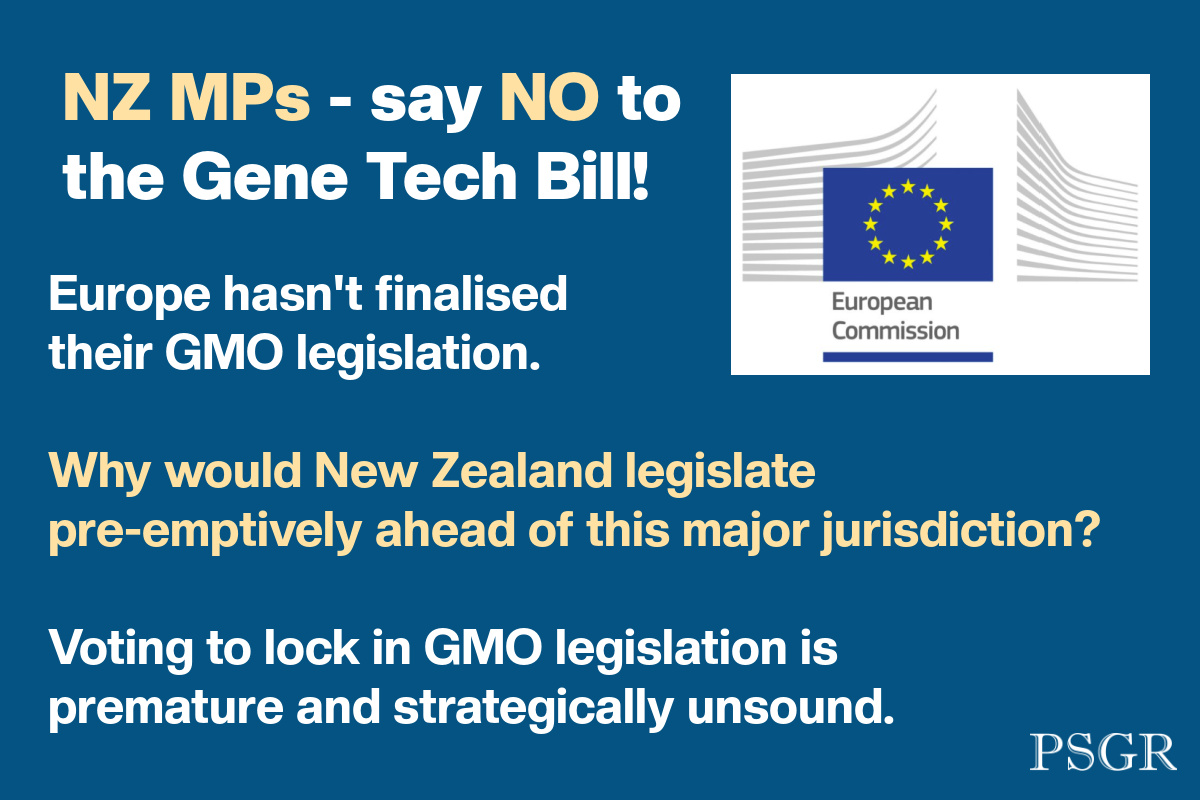
New Zealand charity the Physicians and Scientists for Global Responsibility (PSGRNZ) have emailed an open letter to New Zealand Members of Parliament highlighting that any vote to approve the Gene Technology Bill would be strategically and constitutionally unsound and economically questionable.
A key issue concerns the fact that the European Commission has not finalised their GMO legislation.
In their open letter, PSGR stressed to MPs that the European Union has not settled its position. PSGR emphasized that it would be premature and strategically unsound for New Zealand to pre-emptively legislate ahead of this major jurisdiction when New Zealand is both a small policy-taker economy and a major food exporter.
In preparing the background documents, MBIE failed to adhere to Good Regulatory Practice.
Many submissions to the Gene Technology Bill including PSGR’s, advised that to date, no cost–benefit, risk assessment, or economic analyses have been undertaken. A corresponding report by PSGR (March 2025) later reviewed government policy literature, including work undertaken by the Royal Society Te Apārangi to confirm the absence of risk assessment for legislation that officials have promised will be ‘risk-proportionate.’
As neither benefits nor costs have been verified, any claimed benefits at this stage are simply speculative.
Elvira Dommisse (PhD biotechnology) queried: “How can elected MPs vote for a Bill that is built on promises but not on evidence-based policy? The repetition by prominent advocates that the Bill will be beneficial to the New Zealand economy is built on sand, because these analytical assessments were never undertaken.”
Shifting responsibility of environmental regulation to the economic growth agency is constitutionally unsound.
PSGR’s open letter expressed alarm that MPs would think it is appropriate to shift the environmental and health-based regulation of GMO technologies, which include gene edited organisms, from the Environmental Protection Authority (EPA) – to the very agency charged with promoting economic growth and encouraging the commercial uptake of new technologies – the Ministry of Business, Innovation and Employment (MBIE).
PSGR lead researcher Jodie Bruning commented: “This smacks of the fox in the henhouse. Such an arrangement runs counter to a core principle of constitutional and democratic governance: the separation of regulatory oversight from economic advocacy functions. It’s extraordinarily concerning if MPs can’t see the embedded conflicts of interest in such a policy shift. If they cannot recognise the transfer of powers that is happening under their noses.”
PSGR urge MPs to vote to reject this Gene Technology Bill that has been broadly condemned by the New Zealand public in the submission process, and which continues to be plagued by controversy and uncertainty.


To secure the NZ–UK Free Trade Agreement, New Zealand made concessions primarily in agricultural market access, intellectual property, and investment protections. These were balanced against gains in tariff elimination, services, and Māori economic inclusion.
NZ–UK Free Trade Agreement includes provisions that support cooperation on genetic technologies, particularly in agriculture and innovation.
While it doesn’t mandate regulatory changes, it creates a framework for dialogue and potential alignment.
It’s not evidence that counts, it’s ideology… and the payola.
So its a smouldering pile of shit, that could turn this country into a contaminated hell, no one wants to live on or visit or buy food from. Well done National, you truly are, in this voters estimation, total clowns.
So double speak for selling out the nation to GMO lobbyists and business interests, right?