
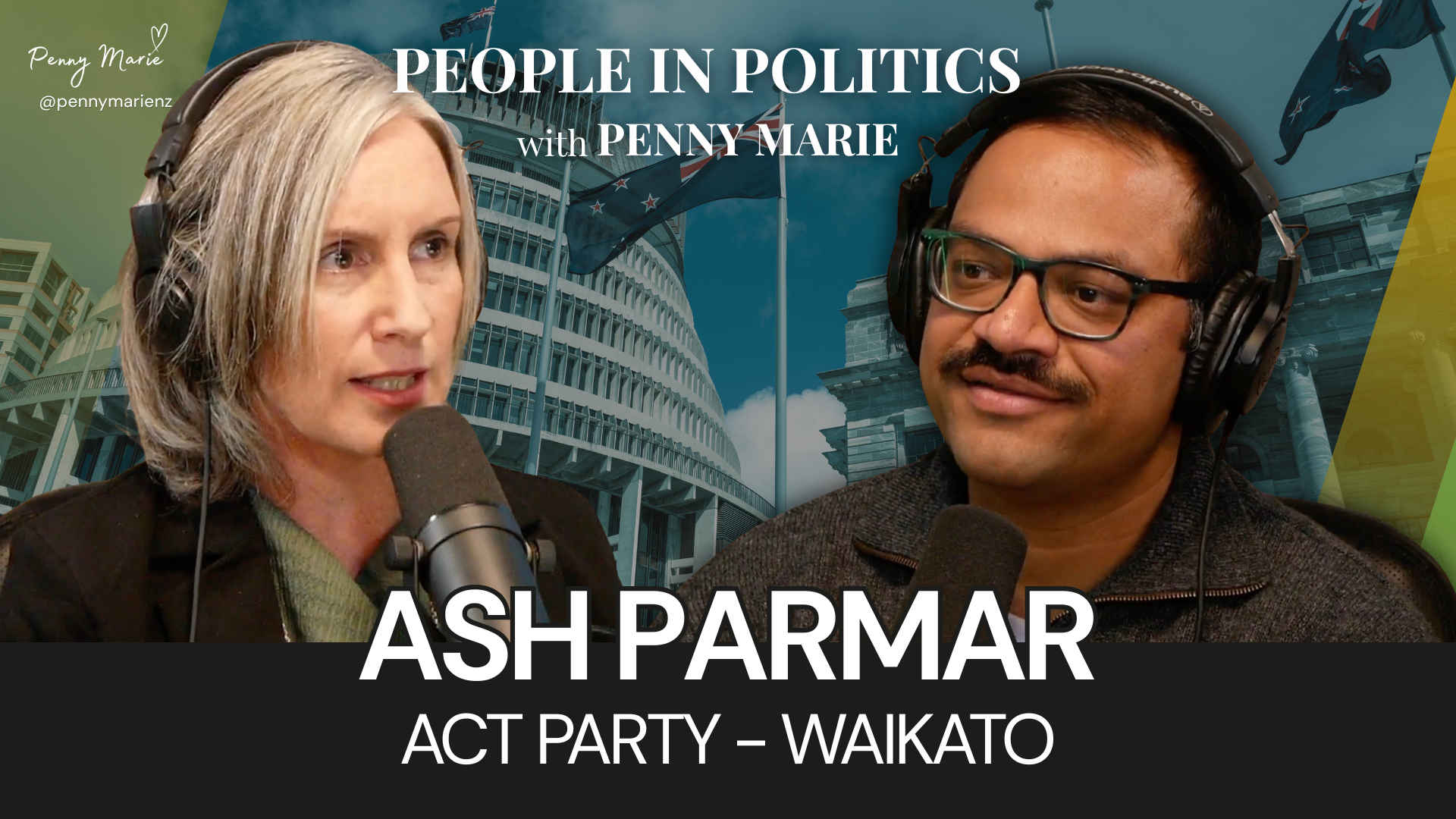
ACT candidate Ash Parmar for Waikato says reducing the cost of living, tackling crime and stripping away unnecessary regulation will be among his priorities as he makes a second bid to enter Parliament at the 2026 general election.
Speaking in an interview on the Penny Marie YouTube channel, Parmar outlined his path from businessman and retail-crime campaigner to political candidate, while discussing immigration, economic development, law and order and ACT’s approach to the public service.
Parmar moved to New Zealand from New Delhi with his parents and younger brother 25 years ago, aged 17, and has spent much of his adult life in and around Hamilton. His family established liquor stores across the Waikato and beyond, giving Parmar around two decades of experience running businesses and employing staff.
His entry into politics was heavily influenced by retail crime. Parmar said his family’s Huntly liquor store was robbed twice within four days in the lead-up to the previous general election, prompting him to campaign publicly for tougher policies.
“I realised it’s the policy change we need, not a bunch of words and promises from other people,” he said.
Parmar previously stood for ACT at number 13 on the party list but narrowly missed entering Parliament. After the election he was appointed to a ministerial advisory panel on retail crime, an experience he said gave him a greater appreciation of how policy and legislation are developed.
He is now campaigning again with a broader focus, including farmers, growers, tradespeople, manufacturers, education and healthcare.
Asked about the biggest concern he was hearing from voters, Parmar gave a straightforward answer: “Cost of living.”
He said conversations at local markets had shown that rising living costs were affecting people across different occupations and circumstances.
Parmar also argued that his experience operating businesses had prepared him for political negotiations. Running multiple stores involved employing workers, negotiating leases and supplier arrangements, responding to changing market conditions and making difficult financial decisions, he said.
He pointed to two businesses his family had closed after they became financially unsustainable, arguing governments should likewise recognise when programmes are failing rather than continuing to pour taxpayers’ money into them.
“You can’t just keep throwing money into a bad enterprise,” Parmar said. “At some point, you have to just make the tough call and shut it down.”
On economic policy, Parmar backed ACT’s emphasis on smaller government, lower taxation, individual freedom and reducing red tape. He argued prosperity is primarily generated by productive relationships between businesses and workers rather than by government.
“Governments don’t create prosperity,” he said, arguing their role should instead be to establish conditions allowing employers and employees to grow and produce.
Immigration was another area Parmar said he felt strongly about, noting that he was himself an immigrant.
He rejected calls to close New Zealand’s borders, saying businesses still need access to overseas workers with skills that cannot readily be found domestically. However, Parmar backed ACT’s position that immigration should target needed skills and said migrants should demonstrate sufficient English to integrate successfully.
He also supported a five-year stand-down before new migrants receive certain welfare benefits, arguing those entitlements had been built through the contributions of New Zealanders.
On diversity, equity and inclusion, Parmar drew a distinction between equal opportunity and policies intended to produce equity. He said people should not be excluded from employment, sport or other opportunities because of their race, culture or religion, but questioned policies that give particular groups additional rights or influence to compensate for historical disadvantage.
ACT’s approach, he said, was centred on “equal rights” and “equal opportunity”.
Parmar also backed ACT’s recently announced “One Public Service for All” policy. He argued public servants should concentrate on providing services and productivity rather than having religious or cultural practices imposed through the workplace.
Employees should remain free to practise their beliefs privately, he said, but neither colleagues nor government employers should force those practices on others.
Law and order remains particularly important to Parmar.
He backed three-strikes legislation, stronger sentencing protections for vulnerable workers and changes to the use of taxpayer-funded cultural reports in criminal sentencing.
Parmar said an offender who robbed him received what he described as a 76 per cent sentencing discount after mitigating circumstances were considered.
While acknowledging that offenders can come from difficult backgrounds, Parmar questioned whether reducing sentences without first addressing offending behaviour adequately protects the public.
“You can’t tell me putting this guy back on the street faster is the right thing to do,” he said.
Asked whether there were ACT policies he opposed, Parmar did not nominate one, instead saying he wanted the party to go further in areas including law and order, reducing the public service and removing regulation.
He acknowledged ACT’s ability to implement its programme was constrained by being one member of a three-party coalition and said a larger ACT caucus would give the party greater ability to advance its policies.
Parmar said that even if he again fails to enter Parliament, he intends to continue advocating on regional economic issues, productivity and crime.
His long-term ambition for the country was summed up during the interview’s rapid-fire section.
“New Zealand in 10 years,” Parmar said, “will be full of opportunity for our younger people.”


I am sure he will accomplish absolutely nothing
A bit like Max Bradfords “Bright Future” power reforms
There is an endless supply
A friggin’ Indian liquor store owner with ZERO knowledge or wisdom about public office aspires to govern.
There you have all what’s wrong with this country.
He’s a perfect candidate for the fake democracy party political system.
Pajeet
Their brains are about as big as their tool
Not the sharpest in the shed
The smallest on the planet the lowest IQ and the smallest brain
NZ woman beware
Don’t get short changed
Buy NZ made
All political parties are ‘for profit’ subsidiary companies of the ‘for profit’ New Zealand Company Church Parliament. King John in the 1215 Magna Carta gave the Church the right and authority to ‘free elections’. In the 1225 re-issued Magna Carta this right and authority to ‘free elections’ evolved into Westminster Parliament/House of Lords, and ever since ALL Parliaments belong to and derive from the Church. The laws that come from these parliaments are for members of the church military orders who are partaking in the lease and occupation of the land.
Painy Marie strikes again.
25 years ago,,, straight off the plane from a failed country and now wants to run shit here,,,,,
These people should not be in politics, he will not represent us, he will just represent his mud mates, he should not even be allowed to vote, all he should get is the right to work, no welfare, the right to pay tax and the right to pay all his bills on time.
Amen
Sounds like just another politician that is ignoring the biggest problem facing NZ today. Unless in word and deed they whole heartedly reject the globalist agenda NZ is going to always be screwed no matter what.
“… governments should likewise recognise when programmes are failing rather than continuing to pour taxpayers’ money into them… ”
The entire fake democracy party political programme is a failure. It has devolved into a circus composed of clowns who are obsessed with the party political process and being associated with similarly detached organisations such as the WEF, Westminster and the White House to such a degree it has become completely detached from the society it purports to represent.
The party political system needs to be replaced. Direct democracy, where the voters decide the issues via regular referendums (based on the Swiss model) would be a great improvement.
Attack the messenger, not the message. Right commenters?
A mouse who lives in a barn is still a mouse, not a horse.
Slipped himself in with the correctly named bunch of phonies too – the slippery ACTORS party…. Hollywood here we come…. The slithering weasel seymours eyes are gonna be darting back and forth in tune with his labour/national puppet-masters with even more extra-enhanced fakeness now…. A Scammer with a sneaky agenda. End of story. Carry on… Next…
All the things ACT have had a whole term in office to accomplish. Yet all we have is social and economic decline, un and under employment, importing cheap foreign labour to take the sprinkling of jobs that are already there, a failing healthcare system and of course crime because people are becoming desperate. Anyone voting mainstream is wasting their vote in my humble opinion. Mind you I’m of the view now that the airport is the solution to the NZ issue for most Kiwi’s. Either that or the place becoming an Australian state.