
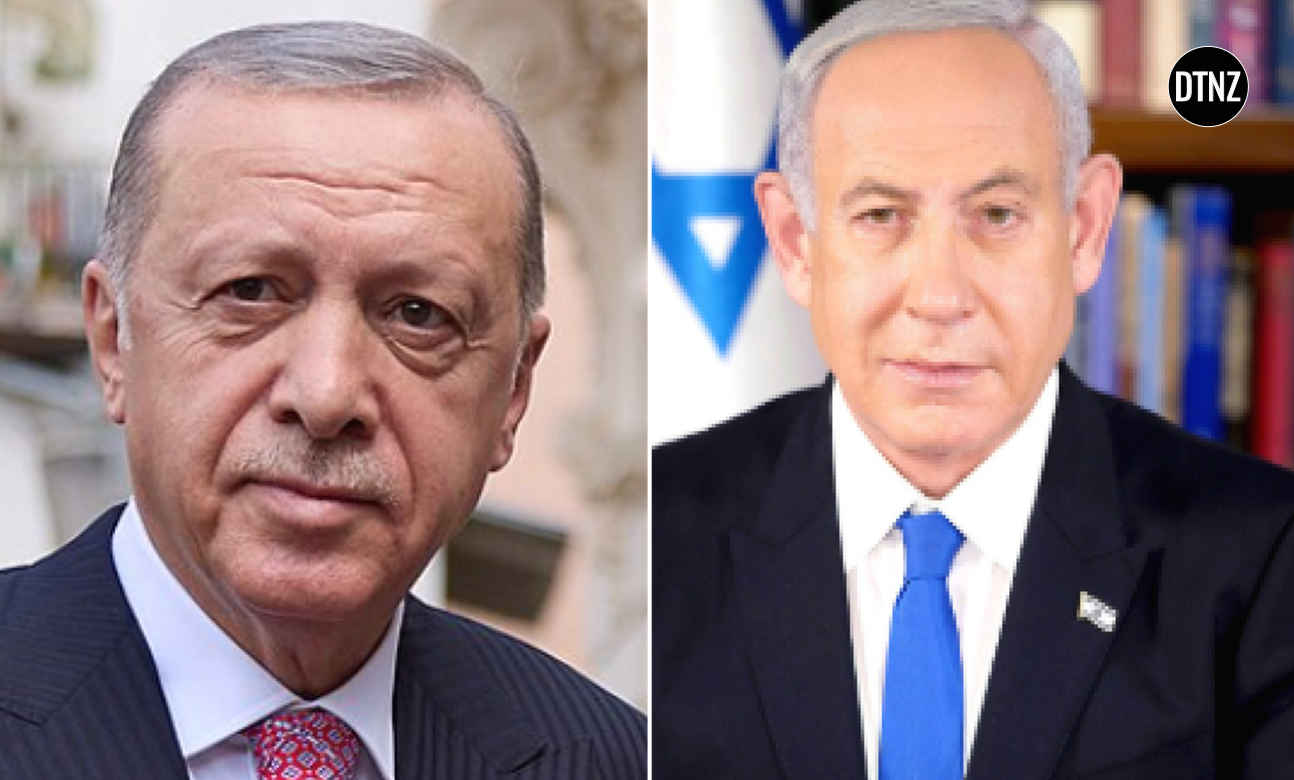
Israeli Prime Minister Benjamin Netanyahu has launched a blistering attack on Turkish President Recep Tayyip Erdogan after Ankara moved to have the Israeli leader internationally sought through Interpol over allegations of genocide and crimes against humanity.
The latest confrontation comes amid rapidly deteriorating relations between Israel and Türkiye, fuelled by the Gaza war and more recent Israeli military action in Syria.
Netanyahu’s office responded on Friday by describing Erdogan as an “antisemitic dictator” who had “massacred Kurds, harbors Hamas terrorists, occupies half of Cyprus, and jails record numbers of journalists and politicians who oppose him.”
The statement also accused the Turkish president of attempting to expand his confrontation with Israel into Syria, declaring that Israel “will not tolerate it”.
“Erdogan’s pathetic attempt to intimidate the leaders and soldiers of Israel, the only true democracy in the Middle East, will go nowhere,” Netanyahu’s office said.
The broadside followed an announcement from Turkish authorities that Netanyahu was among 35 defendants being sought in connection with Israel’s interception of the Global Sumud Flotilla, an activist-organised convoy attempting to reach Gaza.
Turkish Justice Minister Akin Gurlek said the allegations included genocide, crimes against humanity, torture, deprivation of liberty, hijacking a transport vehicle and property damage.
“We categorically reject the notion that the Netanyahu government, which is pursuing a policy of genocide in Gaza, is untouchable and cannot be held accountable,” Gurlek said.
An Interpol Red Notice is an international request to law-enforcement agencies to locate and provisionally arrest a person pending extradition or other legal proceedings. It is not itself an international arrest warrant.
Israeli forces have intercepted several Gaza-bound flotillas in international waters. During an operation in May, more than 400 activists aboard dozens of vessels were detained before being deported to Greece. Some later alleged they were mistreated in Israeli custody, while Israeli Foreign Minister Gideon Saar maintained that those taking part in what he called the “provocative flotilla” were unharmed.
Relations between Ankara and Jerusalem have also been strained by developments in Syria.
Türkiye strongly condemned Israeli strikes on the Abu al-Duhur airbase on 18 August. The attack reportedly damaged newly constructed runways but caused no casualties.
Israeli Defence Minister Israel Katz subsequently warned Erdogan against pulling Türkiye “into dangerous adventures in Syria”. Both Ankara and Damascus rejected Israeli claims that Turkish forces were preparing to deploy in the area, while US presidential envoy to Syria and Iraq Tom Barrack criticised the Israeli strikes as an unnecessary escalation.
Erdogan has repeatedly compared Netanyahu to Adolf Hitler and accused Israel of committing genocide against Palestinians in Gaza. Netanyahu has countered by accusing the Turkish leader of genocide against Kurds and repeatedly branding him an antisemite.
The escalating rhetoric comes as Israel continues to face international legal proceedings over the Gaza conflict.
The International Court of Justice is considering South Africa’s case accusing Israel of violating the Genocide Convention. Separately, the International Criminal Court issued arrest warrants in November 2024 for Netanyahu and former Israeli Defence Minister Yoav Gallant over alleged war crimes and crimes against humanity.
Israel rejects the allegations. While it is subject to proceedings before the ICJ as a party to the court’s statute, it is not a member of the ICC.


The babylonian pot calling the islamic kettle black.
In the meantime they remain good buddies and turkey continues to supply oil
Netanyahu brands Erdogan ‘antisemitic dictator’ after Türkiye’s Interpol plea
That might be true if netanyahu was Semitic
The bigger the lie and the more often it is told the more people will believe it
100%. Most J’s are not Semetic. Their own top scholoars are not shy of broadcasting this fact.
They’re imposters.
Am I anti semetic for pointing this fact out?
Its a shame this creature is not apprehended and jailed given what his government have done. That said, the criminals in the US support him, so he will go one doing as he likes for the foreseeable future.
He cannot escape the damnation of hell
Hell death the grave all the same KJV
Looks like Turkey is lining up to stand with the BRIC’s alliance.
Not really. They are supplying Ukraine with US made weapons and they are part of NATO.
Turkey is only in NATO for the money, when the time comes they will flip.
A gallows has just been erected perfect for hanging Nutyahoo.
Erdogan may be a MOSS asset. They will try & roll Turkey.
Satanyahu is a worshipper of the Back Cube https://static-3.bitchute.com/live/cover_images/2zgijbgahSMp/RrPaQEQMILSEP4Ks05WPnkBL_640x360.jpg
The Ba’al cult never died & they worship the idols & black magic “Hex” ie the symbol on the Israeli Flag is the Black Cube – now you see it??
Once you see it you won’t ever forget it. Watch that blue colour too – it’s everywhere.
Anyone supporting Israel (Zionists) in the Holy Land is supporting Black Cube Magic. WAKEUP.
They are still angry that they lost the covenant after Jesus murder. Its a 2000 year+ war.