When I attended the University of Otago in the eighties I lived in Dunedin.
I am a surfer and I recalled fondly going to the beautiful beach area of Karitane. On returning to Dunedin recently I was pleased to see that a cheap bus went to Karitane on a daily basis. I took the bus, but I was unsure as to whether the bus turned off the highway to Karitane or just continued north. Accordingly, I stopped the bus just before the Karitane turnoff.
When I got off the bus I decided to have a look at the local area. I soon discovered a multistorey building which was abandoned. I thought that was odd. Why would such a large building simply be left abandoned? This was New Zealand after all, and not some third world country. Everything felt odd about the area and so I did not stay long and walked across the highway and headed to Karitane. I was not disappointed with Karitane. In fact, it was better than I recalled. A very beautiful beach area and headland.
About a week later, I was surprised to learn that abandoned building was in an area formerly known as Cherry Farm.
When I was at the University of Otago my friends and I always knew about Cherry Farm. We knew it was a mental asylum, a place no one would want to end up in. But we always thought Cherry Farm was near the student hostel Helensburgh House.
In fact, that mental asylum was not Cherry Farm, it was Wakari.
Interestingly, the doctor Selwyn Leeks who was shamed by the 2024 Royal Commission of Inquiry into Abuse in State Care, worked at Wakari before he went to Lake Alice Hospital child and adolescent unit in the Manawatu.
There is also some confusion about where he worked before Lake Alice Hospital. Many people think he worked at Cherry Farm. He never did, according to historical records.
Just down the road from Cherry Farm are some ruins of the former Seacliff Lunatic Asylum at the Truby King Reserve. The asylum was made famous by the writings of acclaimed New Zealand author Janet Frame.
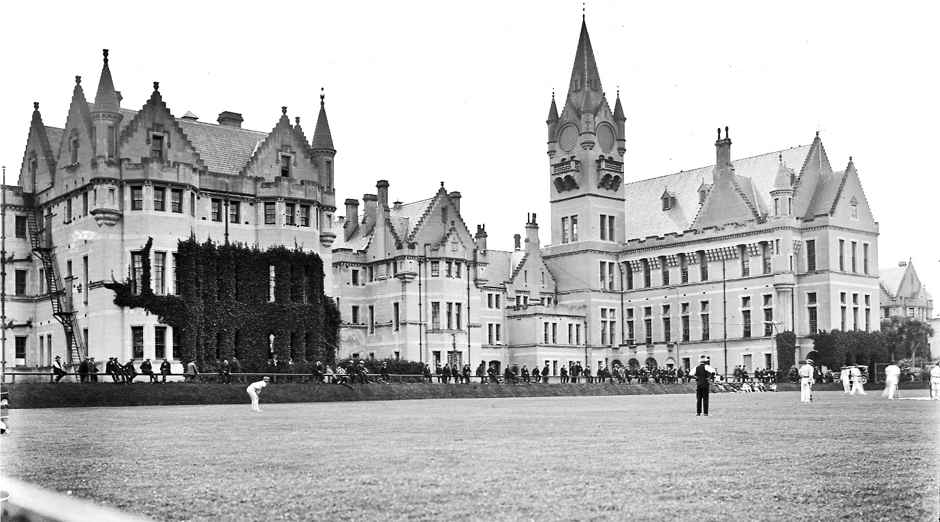
Seacliff was a massive collection of buildings with towers, constructed in a gothic style by the famous architect Robert Lawson. It was the biggest building in New Zealand at that time.
Lawson was the architect for some forty churches including the impressive First Church in Dunedin and Larnach Castle.
Unfortunately for Lawson, Seacliff was built on unstable grounds. Right from the outset there were cracks and bits falling off his masterpiece. He was blamed publicly by high officials who claimed it was badly constructed. By the time a consensus was reached many decades later that in fact it was the unstable ground and slips that caused the problems his reputation was already ruined as a great architect.
In 1942, a couple of years before Janet Frame was sent to Seacliff Lunatic Asylum there was a massive fire in Ward 5 which killed thirty-seven out of thirty-nine female patients who were locked inside and were literally burned alive or died of smoke inhalation.
This was not the reason for the eventual closure of Seacliff though, rather it was the instability of the place, and it was finally condemned and fully closed in 1973. It was later demolished.
There is a very informative video about Seacliff on YouTube. It is a speech given by Daphne Henderson in October 2023 (notably before the final report of the Royal Commission of Inquiry in 2024).
Along with some of her relatives she worked at Seacliff. At Seacliff she was a hospital aide and then a student nurse. At Cherry Farm she was the assistant matron and then the principal nurse.
She starts her speech by stating:
“Now Seacliff Hospital or Seacliff Asylum I absolutely hate hearing people saying that when they walk in the grounds, they can feel the evil vibe for it was a place of horror and torture.”
This statement reflects the flavour of her talk on Seacliff which focusses entirely on the positive aspects of the place rather than addressing the huge elephant in the room which was what went on behind closed doors.
That included lobotomies, electroconvulsive therapy, forced surgery and sterilisation such as removal of ovaries, fallopian tubes, and the clitoris.
It is hard to conclude whether the main motivation for the sexual procedures were eugenics or simply a belief that sexual urges were a hindrance to medical and psychological health.
Part of my research for this article was visiting the Hocken Library in Dunedin.
The notes of Charles Stuart Moore were “unrestricted” and provide some valuable insight into Seacliff Lunatic Asylum and Cherry Farm. Moore was the medical superintendent at both Seacliff and Cherry Farm.
I discovered one paragraph in his notes which stated:
“An alternating current was passed across the patient’s brain at voltages varying between 80 and 150 volts for about a second. The patient was rendered immediately unconscious and nursing staff lined both sides of the couch to hold the patient firm by the shoulders, hips, legs and the jaw to avoid the dangers of the convulsion causing any injury.
Later the treatment was modified by the patient being first anaesthetised and their muscles being paralysed by an injection of curare a drug used by the South American Indians, to put in their darts, to paralyse their prey.”
Nothing like a bit of South American blow dart poison to relax you before your morning buzz.
I shudder to think what the “restricted” documents would reveal, if indeed there are any.
Daphne Henderson describes Seacliff overall as “revolutionary”.
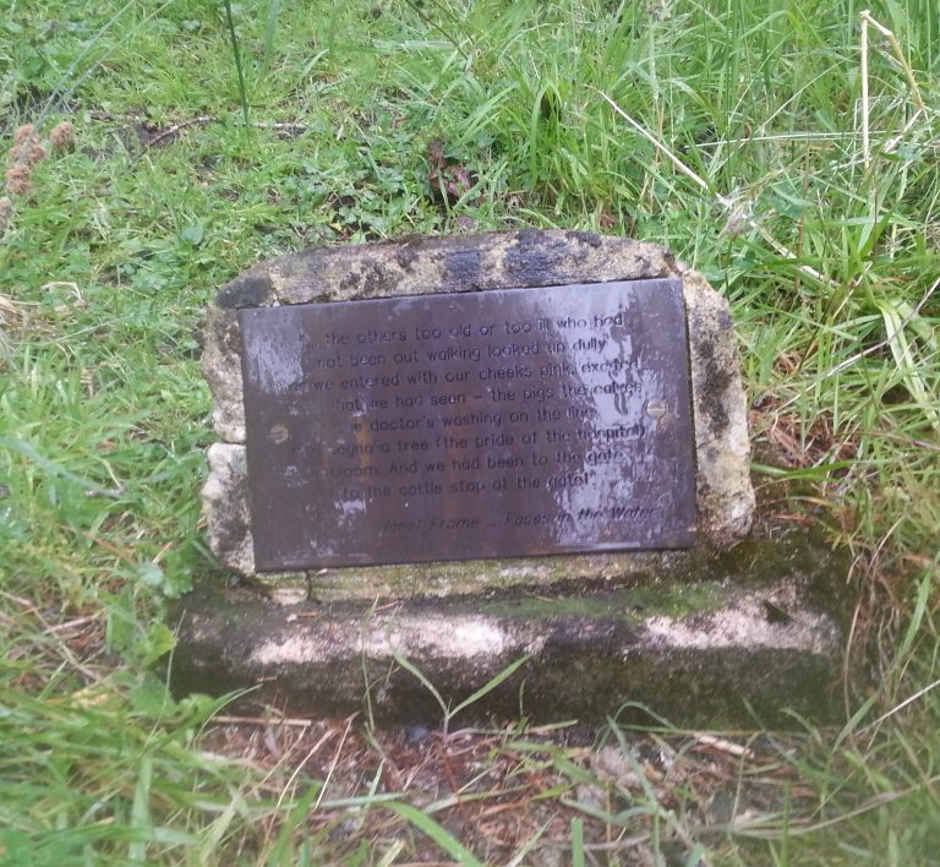
Ironically at the conclusion of her talk Daphne proudly mentions Janet Frame and the memorial plaque now at Truby King Reserve with a quote from Janet’s book Faces in the Water.
I read Faces in the Water and reread, An Angel at my Table.
Janet describes the cruel inhumanity of the place, at times terrible conditions, and bullying by the staff.
As described in the 1990 film directed by Jane Campion, An Angel at my Table, Janet famously only escaped an imminent lobotomy herself (formerly known as leucotomy) because she had won an important literary prize.
Janet wrote of Seacliff “I learned to live as if already dead.”
She also made clear that patients were constantly told the treatment and their being at Seacliff was for their own good.
In this regard she stated in Faces in the Water:
“For your own good” is a persuasive argument that will eventually make man agree to his own destruction.”
When I read this sentence, I was reminded of the Covid favourite, “Safe and effective.”
Of course, history has mostly disproven both claims.
But perhaps more importantly is how people wielding power or influence over other people’s lives and health can so easily become convinced by the truth of such expressions.
Such as in Covid with celebrities, journalists, and politicians making such claims assertively despite themselves having almost zero medical knowledge on the subject.
To my knowledge the writing about Seacliff Lunatic Asylum by Janet Frame has never been challenged, rather celebrated as extremely important.
And Daphne Henderson did not challenge those writings at all during her talk, though that of course would have been a great opportunity to do so.
As Daphne alluded to, these days the Truby King Reserve area is claimed to be one of the most haunted areas in New Zealand.
Getting back to Cherry Farm, which came after Seacliff, it should be noted that the Royal Commission of Inquiry into Abuse in State Care publicly released testimonies of children and adults about their time in the more modern institution which included physical abuse.
At Cherry Farm a new procedure was added called deep sleep therapy (also known as prolonged narcosis) a controversial, abusive psychiatric treatment used at the hospital in the 1970s. Patients were kept unconscious for days or weeks using heavy drugs. The practice was later widely condemned and has been officially rescinded.
From the notes of health superintendent Charles Stuart Moore, I found a disturbing statistic about Cherry Farm:
“In 1962 we had 576 admissions and 137 deaths.”
Cherry Farm was finally shut down in November 1992.
One might think that Dunedin’s notorious treatment of mentally ill patients ended there.
Sadly, that is not the case.
There has been yet another recent investigation by the Chief Ombudsman this time concerning Wakari Hospital.
Inspectors have reported long-term seclusion, prolonged restraints, unlawful administration of medication, denying people access to their own money and people being rewarded for “good” behaviour with access to basic necessities – including the toilet and dental care.
One person was secluded in their bedroom for about 18 months.
Health New Zealand has now closed Ward 10 A of the hospital and there have been calls for an independent investigation.


The Ballentine’s fire in Christchurch and the locking-in of female psychiatric patients during a fire reeks of the Status-Quo:
“Lock them in until they no longer exist!”
These are some of the extremes that the PTB will go to to remove threats to their status, or simply those who ‘do not produce (wealth) for their ‘betters’…!
Useless Eaters we are called nowadays…with hyper-inflation making food unaffordable so that all get malnourished, then sick, then die!
https://justice-4-poland.com/2025/01/23/if-you-are-over-50-your-government-wants-you-dead/
https://www.naturalnews.com/2024-06-07-never-forget-your-own-government-tried-to-murder-you.html
https://www.naturalnews.com/2024-09-09-public-health-agenda-is-a-death-agenda.html
https://thepeoplesvoice.tv/top-doctor-we-were-told-to-deliberately-kill-millions-of-covid-patients-using-ventilators/
So true
According to her Facebook page Daphne Henderson also worked at Wakari when Cherry Farm was shut down, until 2011, so she did the triple.
So what has improved? This recent article also in TDT :
Indefinite detention, psychiatric dependency, and a broken pipeline: Inside New Zealand’s hidden recidivism machine – and also the proliferation of rest homes where the elderly and disabled are often warehoused – all need to be looked at.
These places are magnets for the petty power mongers.
Another thing which has always puzzled me: Seacliffe Hospital was a magnificent building but the logistics of its construction are confusing. Look at the size of it. Look at where it was situated. Everything had to be hauled over practically non-existent roads, probably by bullock trains, 25 miles away from the nearest township. No electricity so even concrete had to be mixed by hand.
Begun in 1874 and completed in 1884 we are expected to believe that this huge building took ten years to build in a country with a total population in the South Island of 200,000 souls with males counted as fewer than 150,000. Stats say 18,000 were goldminers. Take out the very young and the very old, the men already engaged in agriculture and other building, and I just can’t see where the numbers of skilled men were available for such a construction.
It had rooms for 500 patients and live-in accomodation for 50 staff and was not the only mental institution in New Zealand at the time.
Finally, how sick was our early society that such sizeable buildings were considered a priority?
Great points!
You can vote for the Cherry Farm patients or people a lot like them this election.