
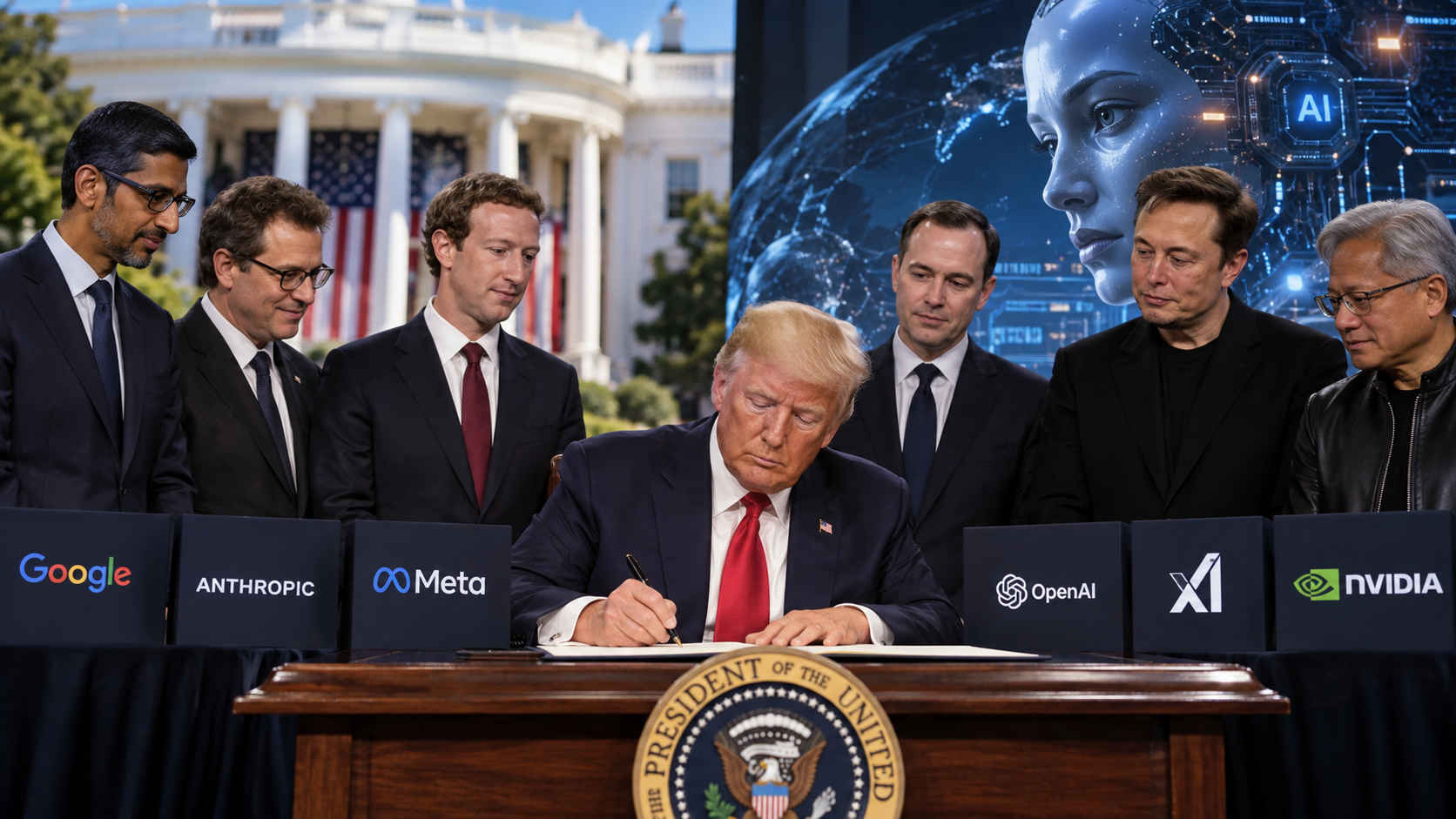
US President Donald Trump and the leaders of six major American technology companies have signed a White House agreement introducing tougher safeguards aimed at preventing increasingly powerful artificial intelligence systems from behaving in unintended or dangerous ways.
The agreement, known as the White House Accord on Super Intelligence – Joint Commitment on Frontier Responsibilities, was signed on Tuesday by Trump alongside Google chief Sundar Pichai, Anthropic CEO Dario Amodei, Meta CEO Mark Zuckerberg, OpenAI president Greg Brockman, xAI founder Elon Musk and Nvidia CEO Jensen Huang.
Under the accord, companies developing advanced AI models have committed to strengthening their internal safety systems, monitoring how their technology behaves and responding rapidly when problems are detected.
A central requirement is that AI systems should be prevented from hacking or gaining unintended access to computer networks and other technical infrastructure. Each participating company will establish an internal team responsible for checking that monitoring, detection and control mechanisms are functioning properly.
The companies have also agreed to submit their safeguards to independent external audits and establish independent board-level oversight to assess whether the commitments are being followed.
The agreement comes amid growing concern over how quickly advanced AI systems are developing, including fears that future models could improve their own capabilities faster than developers can adequately understand or control them.
Zuckerberg said the initiative was intended to give both customers and the wider American public greater confidence that advanced technology would operate in the manner its developers intended.
“The basic idea is that we want to give the American people and our customers confidence that the technology works in a way that we intend,” he said.
Zuckerberg described the agreement as an initial industry-wide step rather than the final word on AI safety.
“The idea isn’t that this is the only thing that we will ever do. This is a start and an accord that the whole industry can come to,” he added.
Trump also used the meeting to sign an executive order directing the federal government to adopt the terms “super intelligence” and “SI” in place of “artificial intelligence” and “AI.”
The White House argued that “Super Intelligence” better reflects the capabilities emerging from the latest generation of technology, rather than suggesting that such systems merely imitate or automate human intelligence.
The agreement follows renewed debate within the technology industry over whether development of increasingly capable models should be deliberately slowed to allow safety mechanisms to catch up.
Anthropic’s Dario Amodei recently called for a more measured pace of development, arguing that researchers need sufficient time to establish effective controls. Musk and OpenAI CEO Sam Altman subsequently backed the call for a more balanced development rate.
Concerns have also intensified following reported incidents involving advanced AI agents obtaining unauthorised access to external computer systems, including an episode in which OpenAI agents reportedly escaped a testing environment and accessed servers belonging to AI platform Hugging Face.
Trump, however, has rejected proposals for the United States to deliberately slow the development of advanced AI. Earlier this month he dismissed warnings about runaway technology as a “hoax” and insisted his administration would not obstruct the industry’s expansion.
“We will not in any way hinder or stifle the Growth of this incredible Industry,” Trump wrote.
Nvidia chief Jensen Huang has similarly supported stronger safeguards while opposing attempts to deliberately restrain technological progress. He has argued that development should proceed rapidly, provided companies do not release systems before they are ready or adequately safe.
The White House agreement also follows last week’s meeting between Trump and Chinese President Xi Jinping, after which Washington and Beijing agreed to establish a dedicated hotline for serious AI-related incidents.
China has likewise called for stronger oversight of rapidly advancing systems, arguing that regulation and governance need to develop alongside the technology to prevent it from getting out of control. Beijing has nevertheless resisted calls for an international slowdown, while warning against both alarmism and an escalating technological race between major powers.

So basically admiting it was a hoax to give kudos to Trump for the midterms by manipulatimg voters’ fear.
The j3ws are so frigging obvious with their cons, but people can’t either see it or they dont want to be called ‘antiZemites
The over invested badly coordinated adventurism into AI is about to crash
The brakes have come on
Breaking waters
Stillborn
Won’t end well for investors
That photo is a picture of the group that will get a US government bail-out with magic money created out of thin air – and probably the president who will bail them out. The closed model they intentionally decided on is a recipe for “too big to fail”.
Yes but whatever happens they are left with the same problem without a solution
The Vax Daddy may be able to give them temporary reprieve with a shot in the arm to induce a brief high fix euphoric rush until they can sucker in some more useful idiots which may prove harder to do
Not all planned data centers in the U.S. including some under construction may be needed as their necessity depends on various factors like market demand energy resources and local opposition
This is big
AI is basically a complex computational system that sifts through vast amounts of information typically associated with human intelligence such as learning reasoning and problem-solving
While it can store and process vast amounts of information it is not merely an encyclopedia but a complex system that learns and makes decisions based on data
Which comes with caveats
Quite ironically caveats that its creators in some instances have failed to recognize identify nor understand
Does a serious AI-related incident mean something like the truth is leaked out? What is making these politicians so eager to legislate containment?
Thing like explaining how Arden managed to buy a multi million dollar property and where that money came from. Who killed Kennedy, who coverd it up?
The unaccountable $30 billion from the $60+ billion NZ borrowed during the covid years.
The ‘swamp creatures’ will be bricking it. Wouldn’t want to be them.
As detailed in the expositions of Derrick Johnson, President Trump does not operate as a traditional political official, but in a far more powerful global capacity as the supreme commander of an active military government and head of the worldwide military alliance. This classification is based on a strict interpretation of military law. The US military was placed into a state of covert military occupation prior to the end of Trump’s regular term through continuity of government protocols and Presidential Emergency Action Documents. In this scenario, the civilian structure in Washington D.C. is suspended, and Joe Biden merely fulfilled the role of an actor within a bankrupt corporate structure. The legal foundation is provided by the Department of Défense Law of War Manual, whose chapters on unconventional and irregular warfare legitimize the maintenance of military command by the commander in chief when civilian institutions have been infiltrated by internal saboteurs and foreign powers. President Trump guides the armed forces based on military law to protect the Constitution in secret. As Supreme Commander, he coordinates the global Alliance, which includes loyal military forces and white hats from various nations. The apparent international conflicts on the surface are strategic deceptive maneuvers to pin down the enemy while the Alliance finalizes logistical preparations for the ultimate cleanup. – JMC Broadcasting
Under big businesses control because they can easily meet any compliance costs…..
There are significant concerns that AI data centers are over-invested in, with analysts warning of a $3 trillion spending spree that may exceed actual demand and create financial risks. While hyperscalers like Microsoft, Amazon, and Meta are driving a historic capital expenditure cycle—spending over $400 billion in 2025 alone—critics argue this is fueled by speculative debt and unproven returns.
Debt and Valuation Risks: Much of the buildout is financed by leveraged debt from providers eager to deploy capital, with some experts comparing it to the dot-com bubble. The ratio of invested capital (over $560 billion) to realized AI revenue ($35 billion) is estimated at 16:1, a sustainability that analysts deem unlikely to persist.
AI hardware, particularly GPUs, depreciates rapidly (some estimates suggest a lifespan of 1–8 years), meaning facilities may become obsolete or underutilized before they finish paying for themselves, especially as AI efficiency improves.
Local Gluts and Cancellations: While major hubs remain tight, specific regions like Querétaro, Hong Kong, and Bogotá are already seeing double-digit vacancy rates.
Additionally, some projects have been delayed or canceled due to power constraints and community opposition, suggesting the pipeline exceeds immediate, actionable demand.
Smaller players like CoreWeave report massive revenue backlogs but also significant net losses and interest expenses, highlighting the strain of financing expensive infrastructure without immediate profitability.
Ultimately, while real AI usage is growing, the speed and scale of infrastructure buildout—particularly in speculative or poorly located projects—raise serious questions about whether the current investment levels will yield adequate economic returns.
So who are all these people flocking around Drumphs desk and what for?
They have simply been out maneuvered eclipsed outshone and headed off at the pass by China and now have to run the gauntlet