
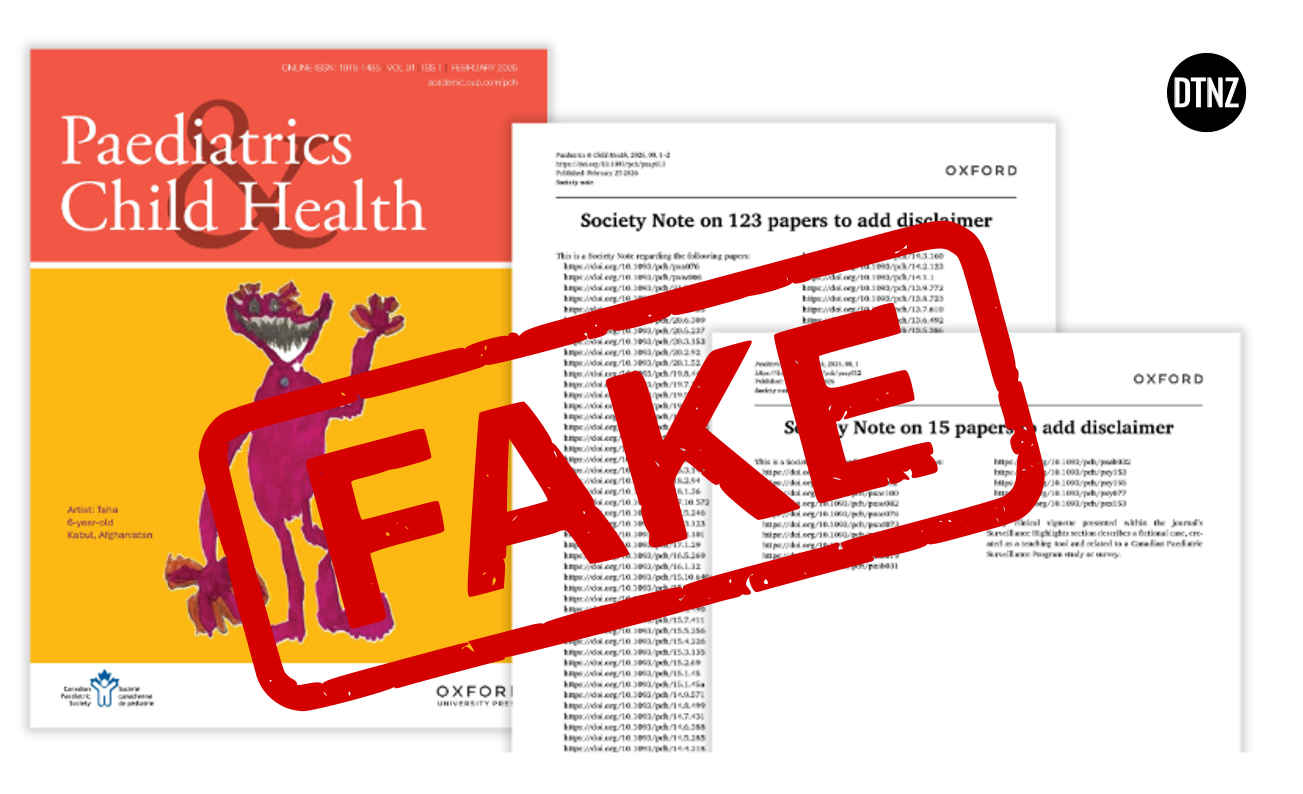
A leading Canadian pediatric journal has issued sweeping corrections across 138 articles published over the past quarter century after acknowledging that clinical case reports presented as authentic medical observations were in fact fictional teaching scenarios.
Canadian Paediatric Society said the corrections affect articles published in Paediatrics & Child Health since 2000, after concerns were reignited by scrutiny over the widely cited “Baby boy blue” report — a 2010 article describing an infant allegedly exposed to opioids through breast milk while the mother was taking acetaminophen with codeine. The journal has now added formal notices stating that every clinical vignette in the series was fictional and created as a teaching tool, despite no such disclosure appearing in the original peer-reviewed publications.
The controversy intensified after a recent feature in The New Yorker highlighted that one of the co-authors of the “Baby boy blue” report had acknowledged the case was invented. The report had long been cited in discussions about whether codeine use by breastfeeding mothers could fatally expose infants to morphine. Medical researcher David Juurlink, who has spent years examining the scientific basis of those claims, said later analysis found the doses described in the report to be pharmacologically implausible and argued the paper should be retracted rather than merely corrected.
The journal’s editor-in-chief, Joan Robinson, said the corrections were introduced to clarify that the cases were intended to protect patient confidentiality and serve educational purposes. However, critics argue that readers had every reason to assume the reports were genuine because they were written and indexed like authentic case studies. Former Journal of the American Medical Association (JAMA) editor George Lundberg said scientific readers have a right to expect published journal material to be factual unless clearly stated otherwise.
The fallout has also affected authors whose work involved real clinical material. Pediatrician Farah Abdulsatar said she was surprised to see her article included among the corrected papers because her case was genuine and previously published elsewhere. The journal acknowledged editorial oversight but indicated reversing the correction would be difficult. Although many of the affected articles were not indexed in major citation databases, dozens have still been cited more than 200 times collectively, raising concerns about how fictional narratives may have entered the scientific record without clear disclosure.


Science at it’s best. You can trust it, safe and effective, blah blah blah.
Science as business model.
Run by ‘experts’.
Lectured by varsity sycophants.
Remuneration and revolving doors waiting.
What could go wrong?
Is where we are.