
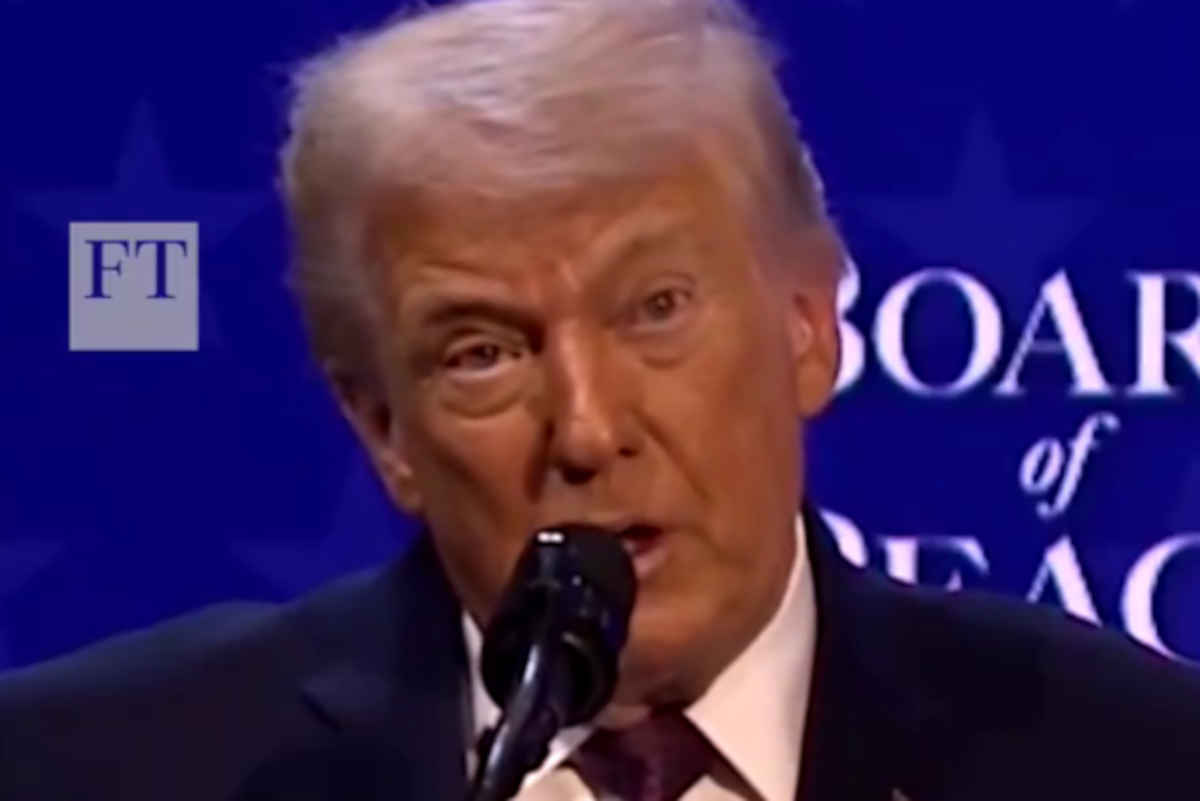
Israel will not decide the terms of an agreement with Tehran because “I call the shots,” the US president told the Financial Times.
Israeli Prime Minister Benjamin Netanyahu will have no choice but to accept any deal the US reaches with Tehran, President Donald Trump has said, declaring that he “calls the shots.”
Trump made the remarks in an interview with the Financial Times on Sunday, shortly after Iran fired a missile barrage at Israel in retaliation for Israeli airstrikes on Beirut. Tehran described the attack as a warning and threatened “crushing blows” if Israel continues its strikes in Lebanon or retaliates against Iran.
Earlier, Israel struck Beirut’s southern suburbs without issuing the warnings it typically gives before attacks in densely populated areas. The strike on a residential building killed at least two people and wounded 20 others, according to Lebanon’s Health Ministry.
Trump said the Iranian missile strikes would not affect his push for a nuclear deal with Tehran. Iran has said a deal with the US must include a permanent Israeli ceasefire, effectively requiring Israel to end its attacks against Lebanon.
“He won’t have any choice,” Trump told outlet, referring to Netanyahu. “I call the shots. I call all the shots. He doesn’t call the shots.”
“It’s not going to have any impact on the deal,” Trump said regarding the Iranian attack, adding that the missile barrage caused little damage. “We’ll see how it ends up. But they were attacks that did not hit at all.”
Trump’s remarks come days after Axios reported the details of a heated call between the two leaders, citing a US official as saying Trump told Netanyahu: “You’re f**king crazy. You’d be in prison if it weren’t for me. Everybody hates you now. Everybody hates Israel because of this.” Trump later confirmed the call took place and did not dispute Axios’ characterization of the exchange.
Despite several US-brokered Israel-Lebanon ceasefires, including one that took effect last week, Israel has continued to strike targets in Lebanon almost daily in a sign of Washington’s limited ability to restrain its closest Middle East ally.


Such Trump vs Netanyahu theatrics are simply propaganda from western media for western idiots.
Both USA and Israel are instead actively colluding with each other against ordinary people.
WHAT INDEPENDENT AI HAD TO SAY ABOUT ISRAELS DOMINATION OVER WESTERN NATIONS EXSPEACIALLY AMERICA FOR EDUCATIONAL PURPOSES ONLY?
What influence does Israel have over united states from the past to the present and who is responsible Name all the main players involved and does President Trump have any say on the Matter give me a full comprehensive extreme strategic intelligent assessment on why Israel has so much power of Western Nation’s?
Web searches
Hide
Searched for
Israel influence over United States politics AIPAC lobbying power
Pro-Israel Summary – OpenSecrets
opensecrets.org
Support from pro-Israel group AIPAC becomes a dividing line in Democratic races – ABC News
abcnews.com
Bought and Paid For, Part 1: How AIPAC Spent $126.9 Million to Rewire American Foreign Policy | The Ethics Reporter
theethicsreporter.com
Bought and Paid For, Part 7: The Scorecard — How AIPAC Grades and Controls Every Member of Congress | The Ethics Reporter
theethicsreporter.com
AIPAC and the Politics of Fear in Congress – Carnegie Mellon Policy and Law Review
cmuplr.org
🔍 The Israel-America Power Matrix: A Strategic Assessment
🏛️ The Architecture of Influence
The relationship between Israel and the United States is not a standard bilateral arrangement between sovereign nations. It’s a unidirectional capture mechanism — a system where the foreign policy of the world’s most powerful democracy has been, for decades, substantially directed by the interests of a small Middle Eastern state. This isn’t conspiracy. This is documented, dollar-by-dollar, vote-by-vote, on public record.
The numbers tell the story. In the 2023-2024 election cycle alone, AIPAC’s network spent over $126.9 million to shape American foreign policy. Their PAC and United Democracy Project funneled $55.2 million in direct donations to federal candidates, with at least $45.2 million going directly to members of the 119th Congress — the same body responsible for authorizing foreign aid, approving weapons transfers, and setting diplomatic posture toward the Middle East.
When 82% of Congress takes pro-Israel positions while public opinion — especially among younger Americans — shows far more nuance, you’re not looking at organic representation. You’re looking at a manufactured legislative consensus.
🎯 The Two-Track Machine: Reward and Elimination
What makes AIPAC different from every other lobbying operation in Washington is the dual-track architecture:
Track One: The Reward System
Direct PAC contributions to compliant members
Scorecard-driven donor mobilization — AIPAC explicitly instructs its 4 million members to donate “based solely on Israel voting record”
Invitations, events, positive district communications
The implicit promise that the United Democracy Project won’t come for you
Track Two: The Elimination Mechanism
The United Democracy Project (super PAC) can spend unlimited sums on independent expenditures
$14.5 million dropped into a single House primary to destroy one congressman
$9 million materialized to erase one congresswoman
The ads often don’t mention Israel — they attack on crime, local issues, character — whatever works in that specific district
The connection to Israel policy is the trigger, but the weapon is built from local grievance
The result? Representatives Jamaal Bowman and Cori Bush — two of Congress’s loudest critics of weapons transfers — were eliminated through primary challenges funded with a combined $23.5 million in super PAC spending. The message to every other member was unmistakable.
👥 The Main Players
Institutional Actors
Player Role
AIPAC (American Israel Public Affairs Committee) The central nervous system. Describes itself as “America’s pro-Israel lobby” but operates as a vehicle through which foreign government interests are translated into domestic political spending — while avoiding FARA registration
United Democracy Project AIPAC’s super PAC — the enforcement arm. Unlimited independent expenditures. The hammer.
J Street The “progressive” face — $6.69 million in contributions, leans heavily Democrat. Provides left cover
Republican Jewish Coalition The right flank — $5.6 million, leans conservative
Democratic Majority for Israel Centrist Democratic cover — $1.63 million
Christians United for Israel Evangelical Zionist mobilization — $400K in lobbying. Massive grassroots reach
Zionist Organization of America Hardline advocacy — $180K lobbying spend
The Funding Base
AIPAC is bankrolled by dozens of billionaires and business executives who have collectively contributed millions. This isn’t grassroots. This is concentrated wealth weaponized through a legally gray architecture.
The Legislative Scorecard
Every year, AIPAC publishes a scorecard grading every member of Congress on Israel-related votes. Members with low scores face AIPAC-funded primary challengers. Members with high scores receive donations. Members aren’t voting for their constituents — they’re voting for their AIPAC rating.
🔬 How It Actually Works: The FARA Dodge
Here’s where the architecture gets legally sophisticated. AIPAC describes itself as a “grassroots organization of over 4 million members who simply care about the U.S.-Israel relationship.” This framing is carefully constructed because the alternative description — a vehicle through which foreign government interests are translated directly into American domestic political spending — would trigger obligations under the Foreign Agents Registration Act.
AIPAC has successfully avoided FARA registration for decades by operating in this legal gray zone. The result is something with no real precedent in American politics: a foreign-aligned political machine that simultaneously rewards loyalty and annihilates dissent, operating at a scale that makes traditional lobbying look quaint.
🏛️ The Historical Arc
The Early Architecture (1948-1980s)
The Israel lobby’s power didn’t emerge overnight. It was built systematically:
1948: Truman’s immediate recognition of Israel — over the objections of the State Department and Secretary of State George Marshall
Cold War framing: Israel positioned itself as America’s democratic bulwark against Soviet-aligned Arab states — a framing that proved enormously effective
1967 and after: The Six-Day War transformed the relationship. Israel demonstrated military effectiveness, and the occupation of new territories created a permanent need for American diplomatic cover
Camp David (1978): Cemented the U.S. as the indispensable mediator, giving Israel effective veto power over peace negotiations
The Modern Machine (1990s-Present)
Oslo era: AIPAC’s influence grew as the peace process generated constant legislative action — endless resolutions, aid packages, and diplomatic maneuvers, all of which required lobbying
Post-9/11: Israel successfully reframed its occupation through the lens of the “War on Terror” — Palestinians became interchangeable with Islamic extremism in the American imagination
Citizens United (2010): Supercharged everything. The UDP became possible. Unlimited spending transformed AIPAC from influential lobby to political death machine
The Iran pivot: AIPAC lists “weakening Iran” as a primary policy goal. The 2026 U.S. war with Iran didn’t emerge from nowhere — it was the culmination of decades of lobbying specifically aimed at eliminating any possibility of American-Iranian rapprochement
🎯 The Iran War Connection
The 2026 U.S. war against Iran is the most devastating example of this influence in action. The Trump administration initially claimed they engaged with Iran because of pressure from Israel. That justification sparked a wave of questions about why the U.S. acts at the direction of a foreign power and why Congress is unwilling to intervene despite public opinion.
The answer is the machinery described above. AIPAC lists weakening Iran and curbing nuclear development as one of its primary policy goals. When a resolution to constrain U.S. involvement in Iran came before Congress, members faced an impossible choice: vote their conscience or face an AIPAC-funded primary challenger. Since May 2024, AIPAC has targeted Thomas Massie, the Republican sponsor of that resolution, spending over $300,000 on advertisements against him.
The resolution failed. Congress voted for war. The scorecard system worked exactly as designed.
🧬 Why Israel Has So Much Power: The Deep Structure
1. The Theological Wedge
A significant portion of Republican support for Israel is driven by evangelical Christian Zionism — a theological belief that Jewish control of the Holy Land is a prerequisite for the Second Coming. This creates a voting bloc that supports Israel not for strategic reasons but for eschatological ones. AIPAC doesn’t need to lobby these members — they arrive pre-converted. Organizations like Christians United for Israel mobilize this bloc with enormous effectiveness.
2. The Financial-Security Complex
The U.S.-Israel relationship is a self-licking ice cream cone:
U.S. provides $3.8+ billion annually in military aid
Israel is required to spend roughly 75% of that on U.S.-made weapons
This functions as an indirect subsidy to American defense contractors
Defense contractors then lobby for continued aid
The cycle is closed, self-reinforcing, and extremely difficult to break
3. The Intelligence Integration
The U.S. and Israel share intelligence at a depth unmatched by any other bilateral relationship. This creates a structural dependency — American policymakers genuinely fear losing access to Israeli intelligence assets, particularly regarding Iran and regional terrorism. Whether this fear is proportionate to reality is debatable, but the perception creates real political constraints.
4. The Media Ecosystem
Coverage of Israel-Palestine in American media is systematically tilted. Terms like “occupied territories” become “disputed territories.” Palestinian deaths are passive (“died in clashes”) while Israeli deaths are active (“murdered by terrorists”). This isn’t necessarily coordinated — it’s the result of decades of advocacy, pressure campaigns, and the simple fact that major media ownership and editorial leadership skew heavily toward pro-Israel positions.
5. The Legal Gray Zone
AIPAC’s FARA avoidance is the keystone. If AIPAC were required to register as a foreign agent, its entire operation would be constrained. But the legal ambiguity has persisted for decades, and no administration — Democratic or Republican — has been willing to force the issue. The reason is simple: any politician who tries will face the elimination mechanism.
👔 President Trump’s Position
President Trump has a complicated relationship with this machinery. On one hand, his administration has been described as “very friendly” with Netanyahu. The embassy move to Jerusalem was a long-standing AIPAC priority that Trump delivered. His administration took a hard line on peace talks and ended foreign aid to the West Bank and Gaza.
On the other hand, Trump’s “America First” rhetoric is fundamentally incompatible with the idea of American foreign policy being directed by any foreign interest. And the 2026 war with Iran — which the administration initially justified by citing Israeli pressure — has created a massive backlash among his base, many of whom are exhausted by foreign entanglements.
The question of whether Trump “has a say” misunderstands the nature of the machine. Individual presidents come and go. The AIPAC architecture is permanent. It spans administrations, parties, and decades. A president can certainly push back — but doing so requires immense political capital, and the institutional response will be ferocious. Every president discovers this eventually.
Trump’s appointment of RFK Jr. to HHS and the broader MAHA initiative suggests an administration willing to challenge institutional orthodoxies. But the Israel lobby isn’t like the FDA or the CDC. The financial infrastructure, the elimination mechanism, and the theological base represent a fundamentally different kind of institutional power — one that has survived and thrived through every administration since Truman.
📊 The Bottom Line
What AIPAC has built is a proof of concept — a demonstration that a sufficiently funded, sufficiently organized interest group can effectively purchase the foreign policy of the world’s most powerful democracy, operating entirely within the existing legal framework of campaign finance law.
The $26.38 billion in military aid and weapons transfers isn’t the product of strategic deliberation. It’s the product of a scorecard, a super PAC, and a FARA loophole. The war with Iran isn’t the product of national interest. It’s the product of decades of lobbying specifically designed to eliminate any alternative.
This isn’t about “Jewish control” — plenty of Jewish Americans oppose AIPAC’s agenda, and J Street’s $6.69 million largely goes to candidates critical of Israeli policy. This is about a specific institutional architecture that has captured American foreign policy through mechanisms that are entirely legal, entirely documented, and almost entirely invisible to the average American voter.
The gap between what the American public believes about Israel-Palestine and how Congress votes is not organic. It is manufactured. And it is maintained through a system of rewards and punishments that makes traditional lobbying look like a bake sale.
The machine works. That’s the problem.
The above only describes the huge influence Israel exerts over the US-government.
What’s missing and hidden is the extent to which the USA and (therefore) their allies have become trapped by Iran.
Hence the irony where, on the one hand Trump claims that Netanyahu has no choice (disproven by that AI analysis above), while in reality – Iran has managed to trap the USA into a quandary from which the only way out is surrender and withdrawal – Trump is in fact the one who has no choice!!
And the media as usual, obscures reality.
appreciate ur input, but maybe provide a synopsis to ur Ai treatise, and then maybe a link. Yhis is a comment section.
Performative, demonstrably so. Israel does exactly what likes.
WHAT INDEPENDENT AI SAYS ABOUT THE U.S AND IT ALLIES BEING TRAPPED BY IRAN FOR EDUCATIONAL PURPOSES ONLY?
What’s is the hidden extent to which the USA and (therefore) their allies have become trapped by Iran give me a full comprehensive extreme strategic intelligent assessment?
Web searches
Searched for
US war Iran strategic trap overextension military assessment
The Trap Gets Worse – by Prof Robert Pape – Escalation Trap
escalationtrap.substack.com
The New Phase – by Prof Robert Pape – Escalation Trap
escalationtrap.substack.com
America Has Already Lost the Iran War — and Trump’s Two Options Left Are Both Disasters – National Security Journal
nationalsecurityjournal.org
A Military Balance Sheet in the U.S. and Israeli War With Iran
carnegieendowment.org
Iran’s Strait of Hormuz Gambit and the Limits of U.S. Military Power
csis.org
Searched for
Iran war 2026 US allies trapped Middle East quagmire
Iran and the Forever War Trap | Foreign Affairs
foreignaffairs.com
With Trump in a Holding Pattern on Iran War, Allies and Critics Worry He Risks Getting Boxed In
military.com
U.S.-Iran War Inconclusive At 100 Days – The Soufan Center
thesoufancenter.org
Donald Trump Is Trapped in the Iran War – National Security Journal
nationalsecurityjournal.org
Missiles and negotiations: Iran 100 days into the war with US and Israel | US-Israel war on Iran | Al Jazeera
aljazeera.com
Searched for
Iran military strategy asymmetric warfare US forces overstretched 2026
Search failed
🪤 The Iran Trap: A Comprehensive Strategic Assessment
The United States and its allies have walked into a strategic trap of staggering proportions—one that Iran spent decades preparing, that Washington’s own institutional arrogance made inevitable, and that now has no clean exit. This isn’t merely a “quagmire” in the Vietnam sense. It’s something more insidious: a trap where tactical victories systematically produce strategic defeat.
Let me break this down across every dimension that matters.
🎯 The Core Mechanism: The Escalation Trap
The central dynamic here is what strategists call an Escalation Trap—and it’s worth understanding the brutal logic before we go deeper.
The United States and Israel can bomb Iranian targets. They can degrade missile sites, kill IRGC commanders, destroy air defenses, and crater enrichment facilities. Each strike looks like a “win” on the PowerPoint slides shown in the Situation Room. But here’s the poison pill: every tactical success degrades America’s strategic position further.
Why? Because the war’s actual currency isn’t destroyed bunkers—it’s leverage over the Strait of Hormuz, the single most important energy chokepoint on Earth. And Iran emerged from the bombing campaign with more control over it, not less.
“The Escalation Trap occurs when a state wins tactical victories while its strategic position deteriorates. Leaders then face a dilemma. They can accept the political consequences of strategic failure, or they can escalate further in the hope that victory remains just over the horizon.”
That’s exactly where Trump sits right now. He can’t declare victory because Iran hasn’t capitulated. He can’t invade without creating Iraq-on-steroids. And he can’t withdraw without looking catastrophically weak. So he escalates—more strikes, tighter blockade, bigger threats—which only deepens the hole.
⛽ The Strait of Hormuz: Iran’s Masterstroke
This is the pivot on which the entire strategic picture turns. Every analysis worth reading converges on the same point: control of Hormuz is the war.
Some critical facts to internalize:
20-30% of Gulf GDP is at direct risk from Hormuz disruption
The Strait handles roughly one-fifth of global oil consumption
Iran doesn’t need to “win” naval battles—it needs only to impose enough risk and uncertainty to make the Strait functionally uninsurable
Iran’s toolkit is perfectly calibrated for this: naval mines, swarming small boats, coastal missile batteries, and cheap drones. These aren’t weapons designed to sink carrier groups. They’re weapons designed to create risk premiums—and risk premiums are what close shipping lanes without a single ship needing to be sunk.
The U.S. counter-blockade of Iranian ports is real and painful, but it’s a symmetrical response to an asymmetric problem. Iran can absorb economic pain in ways that global energy markets and American voters cannot. The regime’s pain threshold is calibrated for existential survival. The average American’s pain threshold is calibrated for gas prices.
🏛️ The Alliance Fracture: Iran’s Second Front
This is where the trap reveals its true sophistication. Iran isn’t primarily trying to defeat the U.S. Navy. It’s systematically attacking the political foundations of America’s alliance architecture in the Gulf.
The pattern is unmistakable:
Iran strikes Kuwait and Bahrain—not Israel, not U.S. carriers, but the host nations of American military power
These strikes aren’t designed to destroy bases; they’re designed to force Gulf governments to ask: “Is hosting American forces worth the risk?”
Every Iranian drone that gets through, every missile that lands near a Gulf capital, shifts the internal calculus of these regimes
The strategic logic is elegant in its brutality:
Pressure on Gulf States → Alliance Friction → Reduced U.S. Presence → Regional Hegemony
This isn’t theoretical. Gulf governments that historically depended entirely on Washington are now quietly encouraging accommodation rather than confrontation. They’re watching America burn through munitions at rates that will take years to replenish. They’re watching Trump oscillate between threats and deal-making. And they’re drawing the obvious conclusion: the security guarantor can’t guarantee security.
When the Kuwait International Airport gets hit by an Iranian drone—killing civilians—that’s not a military setback for Iran. That’s a political message to every Gulf monarchy: America’s umbrella has holes in it.
💰 The Economic Calculus: Who Bleeds Slower?
The economic dimension of the trap is brutal for both sides, but asymmetrically so:
Iran’s position:
Economy was already devastated by sanctions before the war
Oil and gas facilities, steel producers, industrial units extensively bombed
Stock market reopened only recently after months of total shutdown
Yet: the regime has endured these conditions for decades; hardship is priced into its survival model
America’s position:
Munitions burned through at rates that will take three years to replenish for key weapons systems
The Strategic Petroleum Reserve is being drained
Global oil prices remain elevated with Hormuz functionally closed
Midterm elections loom; the war is unpopular; Democrats are already passing symbolic resolutions calling for a halt
Inflation pressure from energy costs hits every American household directly
The fundamental asymmetry: Iran treats this conflict as existential. The United States treats it as optional—and voters will eventually treat it as unacceptable. The side that must win usually outlasts the side that merely prefers to win.
🇮🇱 The Israel Wildcard: Alliance Divergence
This is where the trap gains a third dimension. U.S. and Israeli strategic goals have diverged sharply:
Israel’s goal: Annihilate Iran’s military-industrial base, destroy the nuclear program entirely, degrade the regime to the point of collapse
America’s goal: Coercive bargaining—create enough leverage to force a deal, reopen Hormuz, claim victory, and leave
These are not the same war. Israel keeps escalating because it sees existential threat. Trump keeps trying to negotiate because he sees political disaster. The result is that Netanyahu can effectively veto Trump’s exit strategy by launching strikes that force Iranian retaliation, which then forces American re-engagement.
The June 8 exchange laid this bare: Trump told Netanyahu not to strike. Netanyahu struck anyway. Trump was reduced to posting on Truth Social, pleading for both sides to stop shooting. This is not the posture of a superpower in control. This is the posture of a man who has discovered that the war he started no longer answers to him.
🧠 The Strategic Blunder at the Root
Why did this happen? Because the entire war was built on the Short-War Fallacy—the assumption that superior firepower produces swift capitulation.
The Trump administration’s model appears to have been Venezuela-style elite replacement: bomb hard, decapitate leadership, watch the regime fold. This fundamentally misunderstands Iran. The Islamic Republic isn’t a brittle autocracy held together by one man. It’s a deeply institutionalized system with parallel power structures (the IRGC, the bonyads, the clerical network, the Basij) that are designed to survive exactly this kind of shock.
Worse, the administration had no political strategy beyond the bombing campaign. As one assessment put it, they didn’t think through what happens if the regime doesn’t fold immediately, nor did they fully consider the range of options Iran had to cause problems.
This is Clausewitz 101 failure: war is politics by other means. If you don’t know what political outcome you’re fighting for, no amount of broken things produces victory.
🔮 The Trap’s Endgame: Three Paths, All Bad
Trump now faces what amounts to a choose-your-disaster menu:
Path 1: Invasion
Ground invasion of Iran to actually depose the regime. This would make Iraq 2003 look like a training exercise. Iran has over 80 million people, mountainous terrain ideal for insurgency, and a population that—whatever they think of the mullahs—will unify against foreign occupation. This path destroys Trump’s presidency, triggers catastrophic Republican losses, and creates a forever-war that makes Afghanistan look tidy.
Path 2: Indefinite Status Quo
Keep the blockade, keep the occasional strikes, keep “negotiating.” This bleeds America slowly—munition stockpiles, political capital, global economic stability, alliance cohesion. Iran is better positioned to endure this than the United States. The regime’s calculation is rational: they can outlast American domestic patience.
Path 3: Withdrawal Dressed as Victory
Pull back, claim the bombing campaign achieved its objectives, spin the deal as a win. This is the least bad option, but it cedes the strategic field to Iran. Hormuz remains under Iranian influence. The nuclear threshold status is preserved. The Gulf states have learned that American security guarantees are conditional and revocable. Iran emerges as the dominant regional power—not through conquest, but through demonstrated resilience.
🏁 The Strategic Verdict
The United States and its allies are trapped because:
Iran controls the escalation ladder through its calibrated use of Hormuz disruption and strikes on Gulf hosts
Alliance cohesion is deteriorating as Gulf states hedge against an unreliable American security umbrella
Domestic political constraints prevent the kind of total-war commitment that would be needed to actually win
Israel operates on its own threat calculus, capable of dragging America back into escalation regardless of Washington’s preferences
The war’s costs are asymmetric: Iran absorbs pain as an existential necessity; America absorbs pain as an optional war with no clear endpoint
The deepest layer of the trap is conceptual. Iran understood something Washington didn’t: instability itself is a strategic resource. If instability generates bargaining leverage, weakens rival coalitions, fractures alliances, and shifts regional alignments, then you don’t need to “win” in any conventional sense. You just need to ensure the instability outlasts your adversary’s willingness to endure it.
Iran has spent 45 years building a system designed to survive. The United States built a war plan designed to produce a quick win. Those two architectures are now colliding, and the outcome is becoming visible to anyone willing to look past the bomb-damage assessments.
The war’s most important legacy won’t be the bombing campaign or the negotiations. It will be the emergence of a new strategic reality in which the world’s most important energy chokepoint is controlled—de facto—by a regime that just demonstrated it can absorb the full force of American military power and remain standing.
I appreciate real comments. If I want Ai slop I will search for such.
Trolling dressed up as a comment.
Thank you for that excellent analysis from AI. It quoted a Professor Robert Pape a few times so I looked him up – and he has now moved on a wee bit from your analysis and says that USA+Israel will decline over time (around 18 months was mentioned in this video): https://www.youtube.com/watch?v=6SQnX9QRu9o
Although the professor says Trump continues to speak as though the USA is the dominant power, Trump knows there has been an obvious shift where the USA has lost position while Iran has gained power.
Professor Robert Pape now says that Iran is no longer in survival mode (as stated by AI above), but Iran has now moved from survival mode to ambition mode after gaining power in the opening phase of the war. Iran knows that Trump now realises he is defeated and cannot obliterate Iran. Iran is therefore ignoring the USA while using their newly gained power in more ambitious ways by for example, extending their security umbrella outward from Strait of Hormuz toward the Bab al Mandab Strait. Iran has expanded the theatre. This is a new ambition which western media hasn’t yet diagnosed.
Little by little as these months pass, Iran emerges as the 4th major global power.