
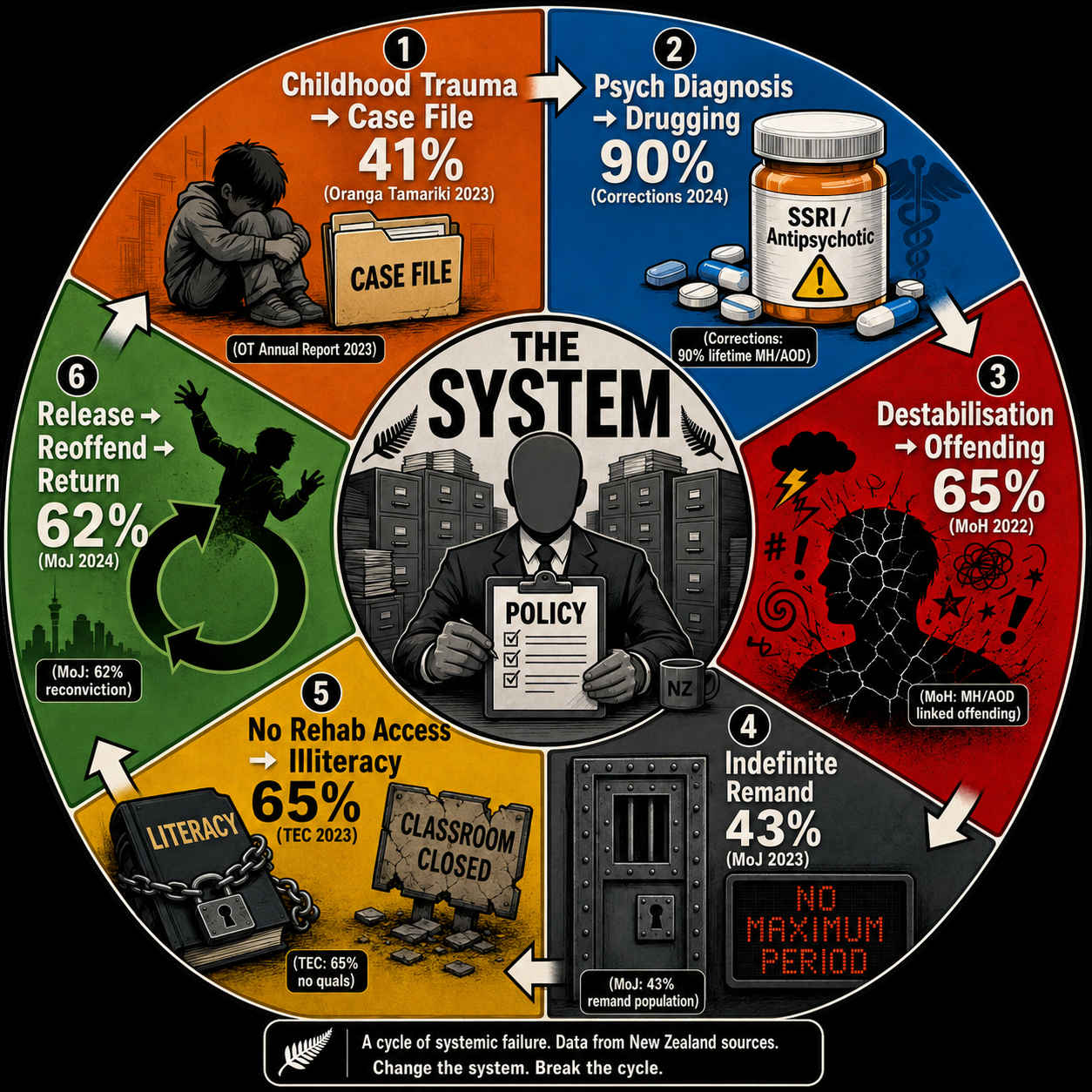
New Zealand’s justice system is facing a crisis that few officials will acknowledge publicly: a closed-loop pipeline that funnels vulnerable people from childhood trauma, to psychiatric dependency, to indefinite remand detention, and back into the community without rehabilitation ― only to return them to prison again.
This loop is not theoretical. It is visible in the 2024-2025 Corrections Annual Report, in court statistics, in youth intervention data, and in the Bill of Rights Act itself. Together, they reveal a system that is not simply failing to reduce reoffending ― but one that is structurally designed to reproduce it.
1. Indefinite remand: New Zealand’s quiet human rights breach
New Zealand has no statutory maximum for how long a person can be held on remand. Court delays, forensic bottlenecks, legislative changes, and resource shortages mean individuals can be detained for months or years without trial.
Corrections confirms the scale of the problem:
- 43% of all prisoners are now on remand (Corrections Annual Report 202425).
- Remand is projected to exceed 50% by 2050.
- It already exceeds 50% for Māori, women, and youth.
Under the New Zealand Bill of Rights Act 1990, this raises serious concerns:
- Section 23: Rights upon arrest
- Section 24: Rights of charged persons
- Section 25: Right to trial “without undue delay”
Legal scholars argue that multi year remand periods constitute de facto indefinite detention, violating the spirit ― if not the letter ― of all three sections.
The critical consequence:
Remand prisoners cannot access rehabilitation, offence based programmes, vocational training, or reintegration planning. They are held in a legal limbo where they are:
- not convicted,
- not sentenced,
- not rehabilitated,
- and not supported.
When released, they return to the community untreated, unskilled, and destabilised ― a perfect recipe for reoffending.
2. Psychiatry’s role: Medication as the default, dependency as the outcome
Corrections reports that 90% of people entering prison have lifetime mental health or addiction issues (Annual Report 202425). This statistic is not incidental ― it is structural.
New Zealand’s mental health system relies heavily on pharmacological management, often without access to psychotherapy, trauma treatment, or long term rehabilitation. Many psychiatric medications carry black box warnings for:
- increased suicidal thoughts
- increased aggression
- emotional instability
- dependency
- withdrawal effects
Sources:
- Medsafe NZ: Black Box warnings for SSRIs and antipsychotics
- FDA: Antidepressant suicidality warnings (2004present)
- Royal Australian & NZ College of Psychiatrists: Practice guidelines
Critics argue that when medication is used as the primary or sole intervention, without addressing trauma, poverty, addiction, or neurodevelopmental issues, it can create chemically destabilised individuals who are more vulnerable to offending.
This forms the first turn of the loop:
psychiatric contact → medication dependency → destabilisation → offending → remand
3. Oranga Tamariki: The early feeder into the pipeline
Corrections reports that 41% of prisoners under 30 had prior Oranga Tamariki family violence intervention (Annual Report 2024-25).
This is not coincidence ― it is a pipeline.
Youth advocates have long warned that children exposed to:
- trauma
- instability
- state intervention
- disrupted schooling
- untreated mental health needs
are significantly more likely to enter the adult justice system.
When these young people later encounter psychiatry, they frequently receive medication rather than therapy. When they encounter the courts, they are disproportionately remanded.
This forms the second turn of the loop:
childhood trauma → state intervention → untreated needs → psychiatric prescribing → offending → remand
4. Remand blocks rehabilitation ― and guarantees recidivism
Corrections openly acknowledges:
“Until a person is found guilty… the available rehabilitation options are limited.” ― Corrections Annual Report 2024-25
Remand prisoners cannot access:
- offence based rehabilitation
- literacy programmes
- vocational training
- trauma treatment
- addiction treatment
- reintegration planning
For young prisoners ― 65% of whom have no qualifications ― this means months or years spent in prison without learning a single skill.
This forms the third turn of the loop:
remand → no rehabilitation → destabilised release → reoffending → re remand
5. The loop: A system that reinforces its own failures
When the components are viewed together, a closed feedback loop emerges:
- Psychiatry creates medication dependency without resolving underlying issues.
- Destabilised individuals commit offences linked to trauma, addiction, or medication effects.
- Courts place them on remand ― often indefinitely.
- Corrections cannot rehabilitate them.
- Release occurs without treatment or skills.
- Reoffending returns them to remand.
- Oranga Tamariki continues feeding vulnerable youth into the same system.
This loop is not conspiratorial ― it is structural. Each institution is operating as designed, but the combined effect is a self reinforcing cycle of recidivism.
6. International human rights context
New Zealand’s remand practice raises concerns under:
- International Covenant on Civil and Political Rights (ICCPR)
- UN Standard Minimum Rules for the Treatment of Prisoners (Nelson Mandela Rules)
- UN Convention on the Rights of the Child (CRC)
Key obligations include:
- timely trial
- access to rehabilitation
- protection of vulnerable youth
- proportionality of detention
- least restrictive measures
Indefinite remand without rehabilitation is inconsistent with all of these standards.
7. A system at breaking point
New Zealand is expanding prison capacity, increasing sentence severity, and tightening bail ― but it is not expanding rehabilitation.
Corrections’ Recidivism Index shows:
- no improvement in reconviction rates
- no improvement in reimprisonment rates
- no improvement in reoffending
Without systemic reform ― in psychiatry, youth services, courts, and Corrections ― the loop will continue to produce the same outcomes, at greater scale.
References & citations (selected)
- Department of Corrections. Annual Report 2024-2025.
- New Zealand Bill of Rights Act 1990, ss 2325.
- Medsafe NZ. Safety Information: Antidepressants and Antipsychotics.
- FDA. Black Box Warning: Suicidality in Antidepressants (2004 to present).
- Royal Australian & New Zealand College of Psychiatrists. Practice Guidelines.
- Oranga Tamariki. Youth Intervention Data (2023-2025).
- UN Human Rights Committee. ICCPR General Comment No. 35: Liberty and Security of Person.
- UNODC. Nelson Mandela Rules (2015).


Thank you for writing such a thoughtful and courageous piece. It shines a light on a system that too often seems to trap people in a cycle instead of giving them a genuine pathway to rebuild their lives. It is sad to see how many opportunities for meaningful rehabilitation are lost, and I truly believe change is needed…People like you, who are prepared to ask the difficult questions and bring these issues into the open, are part of that change! Honest conversations are where better solutions begin! Thank you for your commitment to highlighting what so many choose not to see. Many thanks, Nigel! Blessings, Celestine
Nigel on Daily T! My two favs!
Same!
Every thing you said is true lm in Australia my son has done years on remand and no rehabilitation no courses all maxed security and mangement units
Has no solicitor / lawyer / barrister / attorney been able to help you?
Maybe you should ask an INTERNATIONAL LAW KC Lawyer if he / she could help your son…??
PLEASE NOTE THAT THIS IS THE SAME MODUS OPERANDI THAT IS BEING IMPLEMENTED IN THE U.S., THE U.K., AND IN PALESTINE / LEBANON!
These events, national policies, occurrences, etc. ALL HAPPEN AT THE SAME TIME. This is NO coincidence; it’s Zionist / Noahide Law based events that are stirring globally at the same time EVERYWHERE except in Russia and the Scandinavian countries.
The U.S.’s NDAA authorised ‘INDEFINITE DETENTION’ which is a violation of not only human and civil rights, but also of the U.S. Constitution. That came about under U.S. President Barry Soetoro, aka Barack Hussein Obama…!
Such ‘INDEFINITE DETENTION’ is also ILLEGAL in many other nations!
Most countries are now broke due to hyperinflation, energy problems, and the usury of the International Zionist Banksters.
They cannot afford to implement any of these programs that you see in the chart.
The ‘Prison Officials’ could be doing better with basic literacy skills, but they’re lazy to implement a local program.
The SSRI’s make the problem worse! (NOTE- I am a disabled veteran, and was placed on SSRI’s for almost 10 years until I fled my former country, never to return!!!). Serax, Zoloft, Sertraline, Pamelor, …all of these never solved a problem, but produced brain fog, and made you vulnerable to being exploited by law enforcement via adverse grooming..
The FBI and other ‘Alphabet Agencies’ are criminal organisations!
https://citizenwatchreport.com/ghislaine-maxwells-sister-is-literally-in-control-of-all-the-fbi-computer-systems-including-national-security-epstein-files/
https://www.rutherford.org/publications_resources/john_whiteheads_commentary/fbi_make_work_entrapment_schemes_creating_criminals_in_order_to_arrest_them
And yet the FBI operates permanently in both New Zealand and Australia…!
https://www.theguardian.com/us-news/2025/jul/31/fbi-opens-new-zealand-office
https://www.rnz.co.nz/news/politics/568540/fbi-to-open-standalone-office-in-wellington
https://www.naturalnews.com/2023-11-22-prather-fbi-criminal-terrorist-organization-in-america.html
https://rumble.com/v42yzlq-david-baumblatt-episode-61-american-citizen-flees-to-russia-claims-asylum-a.html
If anything, you may have to run for political office in Australia in order to secure your son’s release, rehab and life back into society.
Stay away from Pauline hanson- she is pro-Israel, and will implement Noahide law and Talmudic Policies.
Lt. Col. Ricardo Bosi’s party is the better fit IF you elect to do that.
“Ms. Berryman, why are you running for public office?”
“I’m running because my son is trapped in a system that encourages violence, failure, destitution, and drug addiction. Once I am elected, I plan on holding the Corrections Portfolio to address the problems presented in the graphic pie chart, and insure that the status quo of the upper class can no longer keep the so called lower class Australians down using a sinister and dysfunctional prison system to remove them from competing for jobs reserved for their little toffs!”
Once I have accomplished this, I will be demanding that the FBI leave Australia, and that Australia steps away from the 5-Eyes spy network!
Of course, this is by design. Politician’s need an enemy they can use to justify their agenda’s, to keep us all “safe” (in other words strip us of our rights and impose a police state). We hear National in particular, banging on about crime and punishment, its one of their band wagon’s for re-election. Callous, hateful lunatics and sadists, who want to hang people, love this narrative and gleefully tick the box on election day.
The sad reality is many of these people come from appalling backgrounds, need help not being thrust into a brutal system that further abuses them. The practical reality too, is if they are not helped they often go on committing crimes, often out of desperation.
In short this is just another reason not to waste your vote on the lying globalists.
‘Abuse in State Care’…all but ignored, and PURE INSTITUTED DELIBERATE HELL FOR THOSE WHO ARE AUTISTIC!!!!!
Where is Autism NZ where the ASD man in Welly is being restrained for ‘weight loss’? The same ASD man who has been sleeping on an old mattress the floor in the ‘mental ward’ for 20+ years in austere conditions??
Where is the NZ Human Rights Commission??
Where is the NZ Law Society??
Where are the pro-bono lawyers who are supposed to uphold International Human Rights?
PARENTS, NEVER EVER SIGN YOUR ASD CHILD / YOUNG ADULT OVER TO THE GOVERNMENT!!!!
The only way that these people will get any help is via the New Zealand Loyal Party’s tax plan which will increase the funding to stop this Zionist Globalist methodology of abuse where MP’s Senators & Con-gressional politicians are making money on Serco stock options imprisoning and keeping ‘offenders’ in privately-run prisons!
NOTE; The Nazi SS Konzentration Kamps were all ‘private prisons’ incorporated by heinrich Himmler and Adolf Eichmann, making money from hair, gold extracted from the teeth of the dead, and slave labour….sounds familiar?
Until the programmed sheeple of Aotearoa / New Zealand stop voting for the Uni-Party & it’s proto-communist minions, these cycles will continue.
The old farts in this country (you know…the Nosy Parkers, and the ones who walk the aisles on Tuesdays of Mitre 10, Bunnings, New World, Woolies, etc. with their hands behind their backs…) need to pull their heads out of their asses, and realise that the Uni-Party is responsible for;
1. Hyperinflation-
2. No price caps on food, petrol, gas, electricity, rent per square meter and health insurance-
3. GRI falling behind the rate of inflation for the last 20+ years-
4. Their shopping trolleys are no longer full, but have an average of only 8 items as compared to 45+ items just 4 years ago-
5. THE GOVERNMENT WANTS THOSE OVER AGE 50 DEAD SO THAT GOVERNMENT WON’T HAVE TO PAY GRI / RETIREMENT BENEFITS!
https://www.naturalnews.com/2024-06-07-never-forget-your-own-government-tried-to-murder-you.html
If it happens there, it then also happens here!!!
https://www.naturalnews.com/2024-09-09-public-health-agenda-is-a-death-agenda.html
https://thepeoplesvoice.tv/top-doctor-we-were-told-to-deliberately-kill-millions-of-covid-patients-using-ventilators/
VOTE FOR THE NEW ZEALAND LOYAL PARTY, AS I SEE NO OTHER POLITICAL PARTY ADDRESSING THE QUIET SUFFERING THAT THE ELDERLY ARE UNDERGOING HERE IN NEW ZEALAND!
New Zealand is broken, that’s very obvious at this point. A horrible, inhumane little colony, ruled by Colonial Governors, we think we elect every three years. They hate us, viciously abuse those who step out of line and re-cycle them through the cruel justice system for political capital. Given how things are getting worse socially and economically, this will not only continue but see more people behind bars in years to come.
Horrible, thanks for publicising this.
Here’s how AI could realistically fit into different parts of the system.
Function AI today Human still needed?
Finding relevant laws and cases Excellent Usually no
Drafting legal documents Very good Review recommended
Predicting likely outcomes Good Yes
Case scheduling Excellent Minimal oversight
Bail risk assessment Possible, but controversial Yes
Sentencing recommendations Possible Yes
Determining guilt Technically possible Strong arguments for human decision-makers
Creating new legal precedent No Yes
Where AI could improve the system
If New Zealand wanted to reduce delays and remand populations, AI could help by:
identifying cases ready for trial
flagging unnecessary delays
summarizing evidence for judges and lawyers
drafting routine court orders
finding inconsistencies in evidence
suggesting relevant case law
translating legal language into plain English
helping self-represented litigants prepare documents
These kinds of tools could make courts more efficient without replacing judges.
Could AI judge a case?
In principle, an AI could apply legal rules consistently. If the law were entirely mechanical, an AI might even be more consistent than humans.
But many legal questions are not mechanical.
A judge may need to decide:
whether a witness is credible,
whether police acted reasonably,
whether detention is proportionate,
how to balance competing rights,
or whether exceptional circumstances justify departing from the usual approach.
These decisions involve judgment and societal values, not just pattern recognition.
A hybrid model
Many legal scholars see the most realistic future as a partnership between AI and human decision-makers:
AI handles research, document review, and administrative tasks.
AI highlights relevant precedents and potential inconsistencies.
Judges remain responsible for decisions affecting rights and liberty.
Humans review AI outputs and provide reasons for their decisions.
This approach could improve efficiency while preserving accountability.
I’d suggest tackling this problem from the bottom up by looking very carefully at the schools to find out why young people are not learning anything useful and leave school without any discipline, practical skills or productive knowledge. Not all of children come under this category, but a not inconsiderable number do. And why does the education industry drug children with Ritalin and similar substances instead of addressing the underlying issues (which could be the quality of the teaching).
Is Oranga Tamariki fit for purpose? Or are they simply magnifying very debatable issues which their wards use as an excuse to develop anti-social and recidivist tendencies?
Television and legacy media bear a lot of responsibility too. The mythical “fourth estate” which theoretically holds the magnify glass to reveal such issues – they have failed miserably. Personally I recommend everyone gets rid of the television – their brains will be much better if they do.