
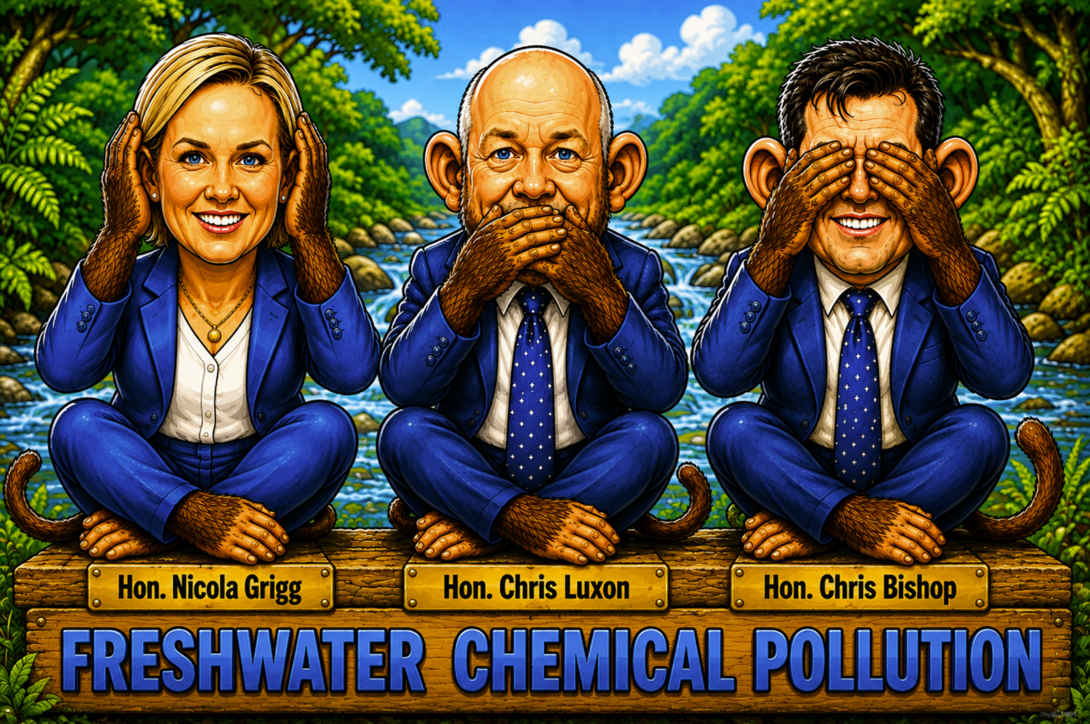
New Zealand keeps rewriting environmental law without building the science frameworks to detect chemical harm. Nicola Grigg is in the middle of it.
At the highest level of government accounting, we count how much water we have and where it flows, but its quality is explicitly missing from the account. What is also missing, from the freshwater policy architecture is any systematic approach to anthropogenic chemical pollution, including synthetic organic contaminants, pesticides, pharmaceuticals, industrial chemicals and heavy and trace metals.
It has become increasingly evident, from recent Official Information Act responses from MCERT and Hon Nicola Grigg, and from the environmental Bills now before Parliament, is that New Zealand continues to build freshwater policy without first building the scientific intelligence needed to identify chemical pressures. At core, I believe, our environmental and freshwater policies are, by sustained omission, designed to fail.
It’s cross-party wilful blindness. We’ve tried to tell them for years. Labour started it, and National are continuing with it.
In 2019, I worked with the Soil & Health Association and PSGRNZ to help write a joint paper Aotearoa New Zealand Policy Proposals on healthy waterways: Are they fit for Purpose? It reflected on a huge, yawning gap in the Government’s Action for Healthy Waterways proposals – the two organisations also sent submissions into the related consultations.
The omission was difficult to explain then, and it remains difficult to explain now. Seven years ago we attempted to explain that a freshwater policy cannot credibly protect waterways for future generations if it does not have a systematic way to identify and investigate significant chemical contaminants.
The Government wanted to talk about nutrients. It wanted to talk about sediment, bacteria and nutrients. There were measures (called attributes) for nitrogen, phosphorus, dissolved oxygen, E. coli, sediment, periphyton, cyanobacteria, macroinvertebrates and fish communities which were subsequently incorporated into the National Environment Standards for Freshwater framework – the NES-FW.
What it did not build was an equivalent national architecture for anthropogenic chemical contaminants from urban, industrial and agricultural sources.
We now have two Bills in Parliament, Nicola Grigg’s Environmental Reporting Amendment Bill 321-1 and Chris Bishop’s Natural Environment Bill 234-2 which are set to reinforce all the problems that I identify here, in brand new legislation.
All the members of Parliament that could be raising a racket – don’t seem to be. Remarkably little political noise is being made about the continued setting-aside of the chemical pollution issue.
The Water Quality Threat: Nutrient Pollution & Toxic Stress by Chemicals
The United Nations is quite clear that the pollutant problem is not just a nutrient problem:
Two water-quality issues with major impact on ecosystem health are nutrient pollution and toxic stress by chemicals.
This issue is not going away, as major documents have illustrated, over and over and over again.
What was strangely absent from the $221 million programme was a systematic policy to identify chemical pollutants, either before they degraded freshwater or when declining ecosystem health signalled a problem. Regional councils were not required to systematically screen for broad classes of toxic chemicals, assess detected mixtures against the scientific evidence, and report the resulting risks.
There’s no guidance, no advice, no Kiwi scientist to call, backed by a government-funded laboratory that can run these panels without imposing costs on cash-strapped regional councils. It is simply not a priority for MBIE, New Zealand’s innovation-and-growth-focused master funder of science.
Pesticides. Herbicides. Fungicides. Pharmaceuticals. PFAS. Solvents. Endocrine-disrupting chemicals. Industrial chemicals. Household chemicals. Plastic-associated chemicals. Urban stormwater contaminants. Their metabolites and degradation products. And, of course, the mixtures – the chemical cocktails – that living organisms are exposed to all at once (which could be considered a combinatory risk. rather like car exhaust particulate matter).
If we do not monitor pollutant chemicals, we cannot know what is present, whether established thresholds are being exceeded, or whether emerging evidence indicates risks for which no regulatory threshold has yet been established. We cannot adequately know whether the water is safe for us or for every organism in the aquatic food chain.
A Media Blackout & No Translation of the Problem into the Public Arena
In 2019, we challenged this gap in the Aotearoa New Zealand Policy Proposals on Healthy Waterways: Are They Fit for Purpose? paper, and jointly submitted that paper to the Government’s freshwater consultation.
That 2019 paper, as you can see on pages 4-5, had many organisations sign on. It was sent to all New Zealand mainstream news outlets as a major press release.
Not a single outlet covered it. It wasn’t relevant enough, or important enough, or … I still do not know why mainstream media elected not to cover such a public interest perspective.
I remain grumpy.
The Government cannot reasonably say that nobody pointed out the problem. The Ministry’s Summary of submissions, published in May 2020, purported to distil the concerns raised in some 17,500 submissions. Chemical pollution did make a fleeting appearance. The document records calls to investigate ‘emerging contaminants’ because of their implications for human and ecosystem health, and elsewhere records concerns about chemicals and emerging contaminants in stormwater and drinking water.
The issue simply disappeared. It did not emerge as a substantive freshwater policy priority. There was no corresponding national chemical-contaminant attribute framework, systematic monitoring programme or policy architecture. The freshwater narrative remained overwhelmingly concerned with nutrients, sediment and microbial contamination.
Seven years later, I decided to find out what happened.
$221 million later
Between July 2020 and June 2025, approximately $221 million was appropriated to the Freshwater Improvement Fund.
I put what I thought was a fairly straightforward question to the Ministry responsible for the environment (July 18, 2026, 26-OIAD-02063): What, during all these years of freshwater policy development and expenditure, had central government done about anthropogenic synthetic chemical contamination?
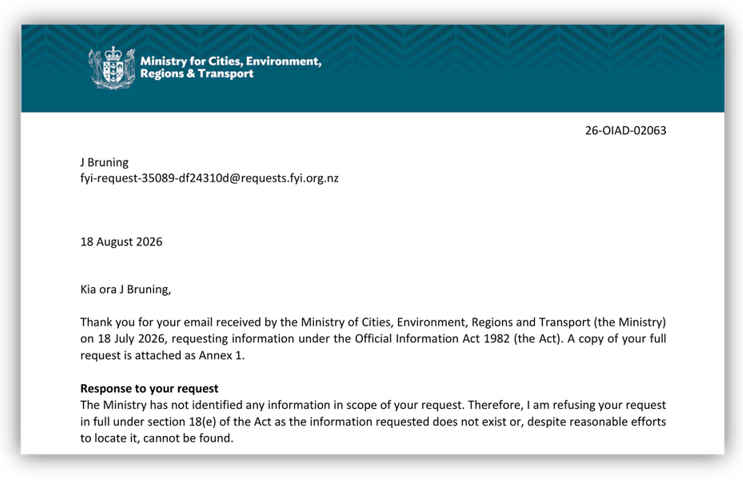
Official Information Act 1982 request response from New Zealand’s Ministry for Cities, Environment, Regions & Transport (MCERT). 26-OIAD-02063
I did not merely ask whether somebody had measured a pesticide somewhere. I requested the extent of policy discussion on manmade synthetic chemical pollutants, moving beyond individual testing for one chemical, to understanding the extent of discussion on any broader policy framework.
I asked for Cabinet papers, ministerial briefings, scientific advice and research. I asked about national monitoring standards, environmental benchmarks and exposure limits. I asked about laboratory capability, contaminant surveys, mixtures and cumulative exposures. I asked what guidance had been given to regional councils. I asked who across government was actually responsible. I asked what had been funded. And I asked what future programme was being developed.
The answer arrived on 18 August 2026. I had not simply failed to find the policy work. The Ministry itself could not identify any information within the scope of my request.
‘The Ministry has not identified any information in scope of your request.’
The request was refused in full under section 18(e) of the Official Information Act because the requested information ‘does not exist or, despite reasonable efforts to locate it, cannot be found.’
And then came the sentence that ought to trouble anyone interested in freshwater:
Ministry for Cities, Environment, Regions & Transport (MCERT)’s August 2022 response:
‘there is currently no work to establish a nationally consistent monitoring framework for anthropogenic synthetic chemical contaminants in freshwater.’
THE GRIGG DEBACLE – IGNORING PCE RECOMMENDATIONS & AN ELECTION MANIFESTO
Nicola Grigg then forwarded another OIA request (26-OIAD-02218) on to MCERT. Grigg held no information discussing the government’s implementation on the Parliamentary Commissioner for the Environment Simon Upton’s eight recommendations made four years ago, in 2022. They concerned the basic intelligence infrastructure needed to manage chemical pollution: knowing which chemicals are used and where, prioritising contaminants for surveillance, systematically monitoring their environmental fate, and feeding those findings back into chemical regulation.
National had explicitly promised that they would implement these recommendations in their 2023 Election Manifesto Blueprint for a Better Environment.
Grigg is currently pushing two bills through Parliament, yet neither embeds the PCE’s recommendations at a high level. She could have done this, but she hasn’t. More remarkably, by pushing the OIA request on to MCERT – I can only speculate – she either doesn’t care about it – or doesn’t want to deal with this policy platform and work programme.
I’m a trustee of PSGRNZ, and our long-term concern about just how poor environmental reporting is in New Zealand, has been expressed to the Environment Select Committee on three different occasions this year, relating to the Hon. Chris Bishop’s Natural Environment Bill (234-2), the Hon. Nicola Grigg’s Hazardous Substances and New Organisms Amendment Bill (304-1), and the Hon. Nicola Grigg’s Environmental Reporting Amendment Bill (321-1). As introduced, these Bills continue to leave the PCE’s chemical-monitoring architecture out of the picture.
However, somewhat impressively, the Environment Select Committee considering Bishop’s Bill (234-2) formally appointed PCE Simon Upton as one of only two independent advisers to the committee, alongside Bronwyn Carruthers KC. The reported-back Bill is substantially stronger on generic environmental monitoring and provides mechanisms that could fund it. The Select Committee recorded Upton’s warning, which is worth repeating:
We received advice from the PCE that effective implementation of environmental limits would require robust monitoring, data, and enforcement. He identified that, compared to the RMA, the NEB generally raises the threshold for what effects are managed—the impact of an effect would need to be larger before it must be managed.
Cumulatively, this would place more pressure on the way the environment is protected through limits. The PCE generally supported the framework proposed for human health limits but expressed significant concern about the bill’s approach to ecosystem health limits. His criticism has two key facets.
First, the PCE suggested that the bill would give the Minister significant influence over decision making. He noted that the NEB contains at least five statutory opportunities for ministerial discretion in setting ecosystem health limits. Depending on the Minister at the time, the PCE stated that this could lead to ecosystem health limits that are “fairly protective” but could equally “permit an increase in pollution and environmental degradation”. In his advice to us, the PCE said “Parliament is effectively being asked to delegate environmental protection to the Executive on terms that are completely open-ended.”
Second, like submitters, it is the PCE’s view that the limits framework provides no “bottom line”. He noted that RMA sections 70 and 107 act as “legislative backstops to prevent pollution” but the NEB contains no equivalent. Councils would be able to set lower limits than the minimum acceptable levels specified in national standards.
Although councils would be required to present a justification report for this, he is concerned that the NEB contains few details about how robust these would need to be, and how they would be assessed and challenged. The PCE suggested that, like human health limits, ecosystem health limits should “prevent significant or irreversible harm” to the natural environment.
Unfortunately, while the reported-back Bill creates broader powers and duties to monitor the environment, it does not establish the scientific intelligence needed to know which chemicals should be monitored. It therefore still does not build the chemical-pollution intelligence system recommended by the PCE in 2022.
Perhaps Grigg should tap Upton and Carruthers to help her with her Bills, too.
What remains missing is a funded national programme telling us what chemical pollution New Zealand should actually be looking for.
HAS MCERT ‘DISAPPEARED’ THE PCE’S RECOMMENDATIONS?
MfE and the EPA had established a work programme across all eight of the Parliamentary Commissioner for the Environment’s recommendations (see April 2024 Briefing BRF-4256 including Appendix), but during 2024 it was progressively absorbed into the Government’s wider hazardous-substances reforms amid changing priorities and resource pressures, with no disclosed decision explaining why the manifesto commitment ceased to be pursued as a programme in its own right.
Why has it failed?
‘Progress varied across workstreams and was not supported by a dedicated funded implementation programme. By 2024, policy priorities had shifted towards broader hazardous substances reform work. Where possible, some of the work relating to the Commissioner’s recommendations has been incorporated into that programme.
If it’s not funded, it won’t get done. Yes – officials were concerned it would be deprioritised, which of course it now has been.
Accordingly, I have sent another request to the Hon. Nicola Grigg (NGOIA162), to ensure that the ‘incorporation’ does not result in any watering-down of these policies (summarised here on pages 11-13).
A current EPA ecotoxicology review (by UK-based, Syngenta client ERM) may address part of the modelling problem, but the wider system envisaged by the PCE, tracking chemical use and environmental presence, prioritising contaminants, setting meaningful limits and linking monitoring back to regulation, has largely disappeared from view. I don’t think the environment is a big focus for MCERT.
Labour and National both own this
It would be convenient to turn this into another Labour-versus-National story but it isn’t. They are partners in this (metaphorical of course) ‘crime’.
The Action for Healthy Waterways programme was developed under Labour. The 2020 National Policy Statement for Freshwater Management followed. The freshwater programme continued for years. National returned to government in late 2023 and has subsequently amended the freshwater framework and embarked on another enormous programme of environmental and resource-management reform.
Labour had the opportunity to put synthetic chemical contamination squarely into the freshwater policy architecture. It didn’t.
National inherited the hole and has not filled it with any relevant policy.
Seven years after we raised the issue, chemical pollution still sits strangely outside the central freshwater narrative.
Ministers for the Environment, Ministers of Statistics, Ministers of Finance (i.e. Treasury) in New Zealand with the most minuscule deviations, have always been red and blue politicians. To my mind, National stalwart Judith Collins occupied an extraordinary concentration of executive power while overseeing the machinery-of-government restructuring that created MCERT.
As Attorney-General and Minister for the Public Service, while simultaneously controlling a bevy of other senior ministerial portfolios, Collins combined roles that placed a potentially unprecedented breadth of legal, institutional and executive authority in the hands of a single Cabinet minister.
Executive power is unusually concentrated and centralised in New Zealand. Cabinet consists of relatively few ministers, individual ministers may hold numerous portfolios, and Cabinet deliberations are protected by substantial conventions of confidentiality. The executive is drawn from and ordinarily commands the confidence of the same House it must answer to, while New Zealand has no upper chamber providing a second legislative check.
Policies can be developed and implemented rather efficiently in New Zealand.
StatsNZ & Treasury: Water Quality Missing from National Cost Accounting
As we noted back in 2019, the policy system is very good at talking about nutrients, sediment and bacteria. These are real problems and should be measured. But measuring nitrate very accurately does not tell you how much pesticide metabolite, PFAS, pharmaceutical residue or endocrine-active compound is in the same water.
A macroinvertebrate index might tell us that something has gone wrong. It cannot necessarily tell us what did it.
Yet we appear to have constructed a national freshwater policy system in which the things government has chosen to measure become, by a rather convenient circularity, the things government knows about.
The blind spot extends to the highest levels of government accounting.
Clean freshwater is essential for human and animal drinking water, food production and the sustenance of freshwater ecosystems, yet water quality is not incorporated into the national water account. New Zealand’s natural-capital stocktake accounts for water principally through stocks, flows and use, while explicitly acknowledging that water-quality measures are missing. In other words, the national asset accounts count the water without accounting for whether it is being chemically degraded.
Let’s be clear here: the population is increasing and water stocks are declining. As the population increases and pressure on freshwater stocks grows, the capacity of freshwater systems to dilute, disperse or transform contaminant loads cannot simply be assumed.
Regional councils depend on the ‘contaminant assimilative capacity of the waterbodies’ and other ‘natural processes that affect the waterway’s capacity to assimilate contaminants’ when setting discharge conditions. Yet nobody is doing the work to confirm that assumption actually holds: that contaminant loads – whether point source or diffuse – are dispersing and breaking down as expected, rather than quietly concentrating as population and industrial pressure both grow.
We can’t know the tipping point, i.e. where critical ecological thresholds might lie, because the Ministries with the power to establish the policies and ring fence the funding have not built the monitoring and research capability needed to find out.
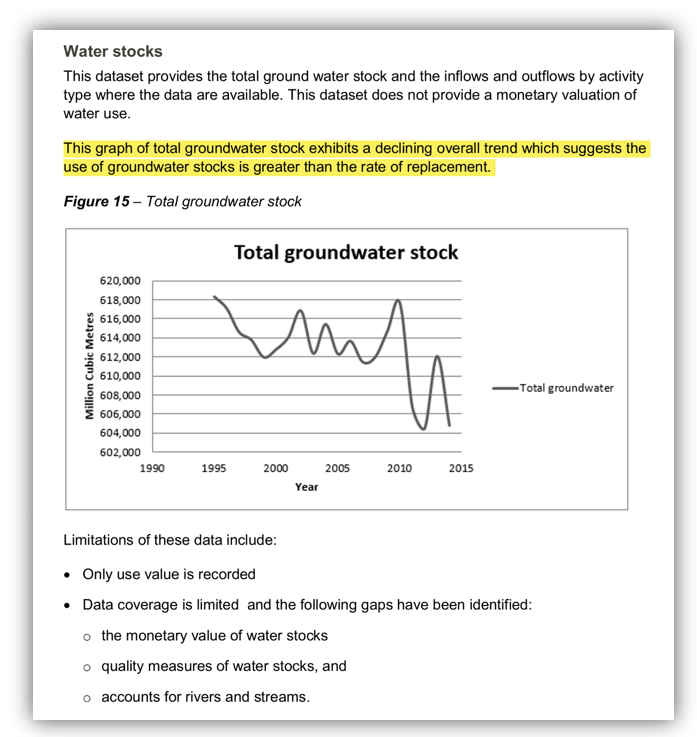
The Start of a Conversation on the Value of New Zealand’s Natural Capital. Discussion Paper 18/03. The Treasury (2018).
Stats NZ’s national water account limits its water calculations to exclusively account for physical stocks and flows. It counts where water comes from, where it goes and changes in its volume, but not the chemical quality of the water being counted.
Statistics NZ (StatsNZ) describes the account as providing information on the national and regional
‘water balance, including the inflows and outflows of water through the inland part of the hydrological cycle, changes in storage, and some estimates of water use.’
The StatsNZ Sources and Methods paper (page 83) shows that the components are overwhelmingly quantitative: precipitation, evapotranspiration, abstraction, discharge, outflows to sea, and changes in lakes, reservoirs, soil moisture, snow, ice and groundwater volume.
We just can’t tell if it is suitable for drinking water and for commercial use – and we can’t project how any declining quality might lead to a tipping point.
Nor is the water stock assigned a monetary value. Stats NZ records water as a physical stock, unlike resources such as renewable energy for which monetary stock accounts have also been developed.
Stats NZ applies the United Nations System of Environmental – Economic Accounting (SEEA) in their Living Standards Framework, acknowledging that this standard refers to ‘the non-quality adjusted stock of natural resources.’
Treasury, in turn, draws on those accounts when assessing New Zealand’s natural capital. Yet the national water account remains principally an account of physical stocks and flows, not water quality.
The omission cascades through all government decision-making, reverberating across policy documents. The 2018 Treasury The Start of a Conversation on the Value of New Zealand’s Natural Capital discussion paper stated ‘Pollution of freshwater is spreading over a wider area’. However the discussion did not identify what that pollution consisted of in any meaningful chemical sense. Pollution was recognised as a problem, while the synthetic chemicals, metals, mixtures and other contaminants that might constitute that pollution remained largely unnamed.
We count the water. We count its movement. We count its use. But we do not account for its chemical integrity.
But there are hundreds of thousands of chemicals!
The obvious objection will come from the realists. The chemical universe is enormous and we cannot monitor everything. Correct.
But that is an argument for developing a rational national strategy, not an argument for having no strategy.
Pharmaceuticals, personal care products, fluoride, solvents, flame retardants and plastic particulates are emitted from wastewater plants. However, if we don’t have any overarching policy to detect, monitor and manage this, the wastewater facilities won’t be pressed to screen for chemicals as best practice, scientists won’t be funded to test for these chemicals, the resourcing won’t be supplied. This expensive work will be out of scope – which is often the case now.
Arable and horticultural industries use far more pesticides and related chemicals than dairy or drystock. Industrial plants can also release a wide range of chemical contaminants.
Nobody sensible is proposing that every stream in New Zealand be tested every Tuesday morning for every chemical ever manufactured. Environmental science is perfectly capable of prioritising.
We can identify classes of concern. We can examine quantities used and released. We can identify persistence, mobility, toxicity and biological activity. We can investigate pathways. We can monitor sentinel chemicals and emerging contaminants. We can look in water, sediment and biota where appropriate. We can establish baselines. We can progressively improve analytical capability as knowledge develops.
Kiwis return from overseas travel, relieved to be back in natural New Zealand where we can drink the tap water.
Chemicals do not politely vanish when governments omit them from policy documents. We cannot presume that the chemicals are degrading at a safe rate. Many persist, many bioaccumulate. Some transform into other compounds. Older contaminants degrade while new ones enter commerce. Many are biologically active or toxic; some can produce effects at low, hormonally relevant concentrations, including through endocrine-disrupting mechanisms.
Wastewater volumes increase. Agricultural and industrial activities change. New products replace old ones. And as New Zealand’s population grows, the volume and complexity of chemical residues moving through wastewater, stormwater, soils and waterways will grow with it.
We will never possess perfect information.
But if we do not even build the institutional machinery to ask, ‘what should we be looking for?’, there can be no serious prospect of prevention.
And now we are legislating again
This would all be merely historical if Parliament were not, once again, rewriting New Zealand’s environmental machinery.
Nicola Grigg is now the Minister for the Environment. The OIA response itself came from the Ministry’s General Manager, Natural Environment. And the same Government is advancing environmental legislation that repeatedly promises better stewardship, better information and protection from environmental harm.
Nicola Grigg’s Environmental Reporting Amendment Bill 321-1 is a particularly neat example. It improves the machinery for reporting environmental information but does not adequately require government to generate the information needed to discover major environmental pressures that existing monitoring misses.
PSGRNZ suggested that Grigg’s Bill could not achieve its objectives because it missed all the upstream requirements. It focussed on reporting but not getting the information in the first place – monitoring.
An environmental intelligence system must help officials and the public to understand: What do we need to know in order to protect the environment, what do we presently not know, and what scientific capability is necessary to find out?
Then came the August Amendment Papers, cascades of Natural Environment Bill and Planning Bill 235-2 amendment papers. While all this tinkering was forewarned, no explanatory reports have been lodged in the parliamentary dockets or on the Ministry for Cities, Environment, Regions and Transport (MCERT) repository. But from what I can identify amongst the thousands of words, there is still no systematic approach to monitoring. It’s an impressive amount of law devoted to regulating what we apparently still don’t intend to look for.
It all seems so impulsive, ad hoc and just so, well, messy.
We risk becoming increasingly sophisticated at reporting our ignorance.
There is another uncomfortable parallel in Chris Bishop’s Natural Environment Bill 234-2, now before the House as part of the replacement for the Resource Management Act. Parliament describes Bishop as the MP in charge, and the Government says one of the Bill’s objectives is to ‘safeguard the environment and human health’, including protecting human health from harm caused by contaminants. It talks about contaminants a lot and monitoring, but the monitoring architecture lacks teeth – it’s a toothless regulatory scheme.
‘the proposed adaptive management approach [104], which can apply to natural environment plans, lacks sufficient transparency to ensure that any monitoring data (including the monitoring protocols and lowest detectable level disclosures for the instrumentation used by actors) are publicly accessible, scientifically robust, and capable of protecting the environment over the long term.’ (Page 6)
A law can empower somebody to set an environmental limit. It can regulate a discharge. It can require a consent. It can promise to safeguard water and human health.
But first somebody has to know what is there.
If there is no systematic surveillance, no national contaminant framework, inadequate environmental toxicology and analytical capability, and no institutional responsibility for finding emerging chemical pressures, how exactly are we supposed to know which limits need setting?
We keep designing regulatory machinery downstream of a scientific capability that we have neglected to build.
The environmental problem we don’t look for
In 2019 we told the Ministry for the Environment that there was a hole. Seven years later I asked government for the paperwork showing what it had done about the hole.
The answer, in substance, was: we can’t find any.
Sediment, bacteria, and nutrients. Sediment refers to sediment flows rather than the capacity for toxic chemicals and their metabolites to persist in sediment. Bacteria was a no-brainer (but we also know from New Zealand and international research that antibiotic-resistant bacteria can be amplified by, for example, pesticide exposure). Nutrients largely concerned leaching from dry stock and dairy farms of superphosphate, urine and cowpoo. Fair enough (but I suspect the myopic focus on energy/dry matter had a bit to do with MBIE’s starving of public good research for soil nutrition, making the situation worse).
Dry stock and dairy farmers were the ‘baddies’ in this play. Chemicals were essentially out of scope – therefore the intensity and toxicological significance of pesticide use in arable agriculture and horticulture was not ‘a thing’. Chemical use varies greatly between agricultural land uses. An Australian national-scale analysis (Navarro et al 2021) found that, per hectare, horticultural production generated approximately ten times the aquatic ecotoxicity hazard and five times the human toxicity hazard of broadacre cropping, while livestock production contributed the least pesticide toxicity hazard.
You might point to ESR’s national groundwater monitoring programme. However, this programme detects chemical mixtures but does not report on the risk presented by total contaminant loads. Monitoring has found wells containing up to six pesticides and up to eight PFAS compounds, yet the results are principally interpreted compound-by-compound against individual reference or drinking-water values.
The national indicator does not appear to aggregate contaminants by toxicological class, common mechanism or cumulative burden, nor assess the combined toxicity of pesticides, PFAS, metals and other organic contaminants occurring together. Heavy-metal monitoring is itself spatially and temporally inconsistent, while emerging organic contaminants remain incompletely incorporated into national reporting.
Landfills provide another obvious pathway. Individual sites may be required through resource consents to monitor leachate and surrounding groundwater, but New Zealand does not appear to have a nationally coordinated surveillance programme that routinely tracks the range of synthetic chemicals escaping landfill into groundwater and freshwater.
Therefore, apart from the groundwater monitoring strategy, the regional council chemical screens and surveys are fragmented and inconsistent, reflecting the absence of a nationally coordinated framework and dedicated funding priority.
Currently, there is no policy that will protect us, as the population intensifies, from having to buy plastic water in a bottle in the years to come – as people do in the US, Asia, Africa and Europe.
New Zealand should not drift towards a future in which confidence in drinking-water quality declines and bottled water increasingly becomes the default.
We must have strategies to monitor, identify and prevent contamination before remediation becomes necessary. We have neither the long-term funding nor the scientific policy needed to ensure this is undertaken, and to prevent New Zealand drifting into the bottled-water trap.
The Ministry for the Environment – now shelved inside the mega-ministry MCERT – confirmed that there is still no work underway to establish a nationally consistent monitoring framework for synthetic chemical contaminants in freshwater.
This has outlasted governments. Perhaps it is time to stop treating it as an unfortunate oversight and consider it as a broader political and scientific failure. We regulate what we know about, monitor what policy tells us to monitor and report what we have monitored. Then we point to the resulting reports as evidence that we understand the environment.
This creates an informational feedback loop. Intelligence. Which New Zealand does not have.
You cannot protect an environment from harms you have never built the scientific capacity to find.
When we don’t know the problems, we can’t ‘innovate’ to find solutions. This is where Europe is eons ahead of us, for example, in developing robotics to use in agriculture to lessen pesticide use. They’ve been working on reducing pesticides much more than we have, while we have many chemicals in our waterways that are banned in Europe.
We’re missing the signals – so we lagged in this form of innovation, and now our farmers have to import European machinery.
And after seven years, two governments, $221 million in freshwater funding and yet another round of environmental legislation sitting there as Bills – still side-stepping discussion of environmental chemicals – I think New Zealanders are entitled to ask why on earth National and Labour keep failing to address chemical pollution, year after year.
I’m not sure it is a priority policy to address in the election – for any of the political parties who have elected representatives sitting in Parliament in 2026.


Stopped reading at awa wank a rower. We live in New Zealand.
NZ is a failure especially when it comes to the clean green mantra… what a lie… it caught us out moving here from the UK thinking at least one country might be headed towards organics or regenerative farming… our home in the far north used to have eels by the dozens and a small pond we had attracted shags to come dive for them, eat them and open their wings in the sun to dry after eating 2 of them… Someone in the hills behind us decided to arial spray for blackberry… it killed off the eels… not a one seen since then about ten years ago now and yet we have had some Maori people studying the river water here…for what I don’t know… the problem is exactly what you described… designed to fail and ignore real issues… just like the rest of the country… both Nats and Labour are guilty.. I don’t see this current green party doing anything other than pushing the lockdown of the right to travel and work and pushing perverse sexuality… they ignore the whole reason that party was started decades ago…