
Part 4: Radical Islam is already inside the gates.
Trevor Phillips’ documentary produced political and social shockwaves in Britain, but there was really no justification for surprise. Several television documentaries in the previous decade have given evidence that there is plenty of cause for concern including Channel 4 Dispatches documentaries “Undercover Mosque” and “Undercover Mosque – The Return” and “Lessons in Hate and Violence – -Islam”
On November 22, 2010, the BBC broadcast a Panorama documentary British schools, Islamic rules, an investigation into the influence of Saudi Arabia on what was being taught in some British schools. The investigation centred round the Jame’ah mosque in Leicester, and several institutions linked to it. Among the latter was a fatwah service, which gave rulings on religious matters. On the role of women it stated that
“a female should remain within the confines of her home as much as possible. She should not come out of the home without need and necessity.”
The service also stated that Muslim lawyers should not assist fellow Muslims to gain asylum in Britain in order to escape death by stoning (emphasis added):
“To assist and aid such people would be unacceptable, impermissible and highly sinful.”
Panorama also investigated a network of part-time schools with connections to Saudi Arabia, involving 5,000 children in over 40 weekend clubs and schools. The textbooks were imported from Saudi Arabia and followed the official Saudi curriculum by which 15-year-olds learned about Sharia and its punishments. Theft, for example, resulted in amputation of a hand for a first offence and foot for a second. Viewers were shown a textbook with diagrams indicating where the cuts must be made. They were also taught about the execution of homosexuals by being thrown off a cliff.
Apparently, they weren’t told about the ultimate Islamic barbarity – stoning to death of women for adultery.
The horror of stoning (‘lapidation’) is graphically shown in The Stoning of Soraya M, a 2009 film adapted from French-Iranian journalist Freidoune Sahebjam‘s 1990 book La Femme Lapidée. It deals with the death by stoning of Soraya Manutchehri who was falsely accused of adultery in Kupayeh, a remote village in Iran in 1986.
I hadn’t the stomach to watch all of it, but short extracts are sickening enough. Below is a screenshot of one scene.
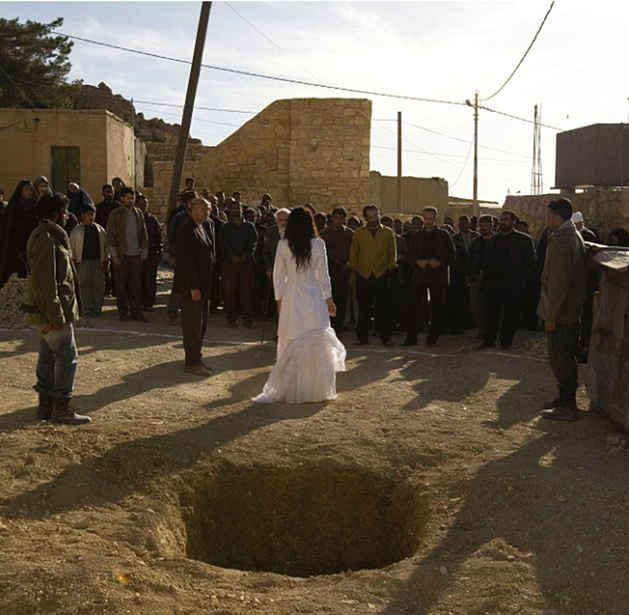
The Stoning of Soraya M. was based on true events in Iran. Other countries in which stoning is part of the legal system are Afghanistan, Brunei, Iran, Iraq, Nigeria, Pakistan, Saudi Arabia,[Sudan, Somalia, and Yemen.
These are all predominantly Islamic countries, so you might think it couldn’t happen in Britain. But there are UK Islamist citizens who are far from opposed to it. Sheikh Zakaullah Saleem, is the Head Imam at the Green Lane mosque in Birmingham. He was born in Pakistan, where he received his Islamic education, and came to the UK in 2002. In August 2023 he explained to his congregation the correct procedure for stoning a woman to death:
The woman found guilty of adultery must first be “buried up to her waist to safeguard her modesty”, only after can the throwing of stones begin, which ends when the convict dies of her injuries.
That the ‘correct procedure’ for such degenerate barbarity can be preached in Birmingham is beyond comprehension, yet that same mosque had been offered a £2 million grant by the Department for Culture, Media and Sport (DCMS) to build a youth centre. This was despite having a track record of preaching that a woman should not leave the house without her husband’s permission, and should always be available to satisfy his desires, thus by implication condoning marital rape. More details are in the Daily Mail, 3rd of September 2023.
These details elicited the standard accusations of ‘Islamophobia’, to which the appropriate response is to remember that the definition of a ‘phobia’ is an irrational fear.
Was Soraya Manutchehri being ‘irrational’ in her fear? And would gays be irrational in being terrified of being thrown off the top of a tall building?
‘Islamophobia’ -a gag to stifle free discussion, and a threat to free speech
To counter criticism of Islam, in 2018 the All Party Parliamentary Group (APPG) on British Muslims devised a definition of Islamophobia which was quickly adopted by the Labour Party, the Liberal Democrats, the SNP, the Scottish Conservatives, Plaid Cymru and the Scottish Greens, the Mayors of London and Manchester, and one in seven local authorities in England:
“Islamophobia is rooted in racism and is a type of racism that targets expressions of Muslimness or perceived Muslimness.”
This doesn’t even pass the sniff test; Islam is not a ‘race’. Indeed, it is self-contradictory; race’ or ethnicity is biological and fixed, but Islam is a religion from which one can cease to be a believer.
As Richard Dawkins perceptively points out:
The fact that you can’t leave your race means that, if Islam is indeed a race, apostasy is literally impossible. Yet apostasy has to be possible or it couldn’t be punishable by death. So the statement Islamophobia is a form of racism is more than just incorrect. It contradicts a fundamental, and incidentally obnoxious, tenet of Islam
A more accurate term would be ‘anti-Islamism,’ meaning ‘dislike of Islam,’ but it would be impossible to base legislation on this since there are so many features of Islamic doctrine that the great majority of UK citizens dislike.
These points aside, there is one aspect to the APPG definition that is not widely known but has been reported in a research note by Policy Exchange, an independent UK think tank. Much of the following draws upon information in this research note.
Most significant in the development of the definition was a particular individual on the APPG’s staff by the name of Muhbeen Hussain, who hails from Rotherham. Hussain founded the British Muslim Youth (BMY) group, and in the aftermath of the Rotherham grooming scandal the BMY boycotted the police, over what they perceived as the persecution and scapegoating of Muslims. In an online message the group ordered fellow Muslims to immediately sever all ties with the police or face being made outcasts in their own neighbourhoods.
The BMY said it could no longer trust South Yorkshire Police because of the continuing “marginalisation and dehumanisation” of Muslims.
The APPG specifically mentions “the issue of ‘grooming gangs,’” placing it in inverted commas, thus implicitly disputing its reality, as a “real life example” of Islamophobic criticism that “humiliates, marginalises and stigmatises Muslims.” Acceptable criticism of Islam must be narrowly circumscribed, because the “supposed right to criticise Islam results in nothing more than another subtle form of anti-Muslim racism.”
As numerous official reports have found, not only did the grooming gangs exist in Rotherham, but a major reason why they went largely unhindered was that people in authority were afraid of being branded racist or anti-Muslim if they acted. The largely Pakistani perpetrators, were given special treatment because of their race and/or religion.
Muhbeen Hussain was a key member of the APPG’s staff when it wrote the report creating the Islamophobia definition. There are repeated references to his role in the APPG during the spring and summer of 2018, when the definition was being prepared.
If it’s not already clear by now that the purpose of the concocted ‘Islamophobia definition is to stifle criticism of Islam, several examples provide proof that even without the definition it already has.
Even though the Jay report had been established beyond doubt the reality of Pakistani grooming gangs, a number of prominent people who had raised the issue were smeared with the ‘Islamophobe’ label, two examples:
- In 2017, three years after Jay, Louise Casey, whose report found that Rotherham council, was “not fit for purpose”, was shortlisted by the Islamic Human Rights Commission (IHRC) for its annual “Islamophobe of the Year” award.
- A year later, Sarah Champion was shortlisted by the IHRC for the same accolade.
What does the Qur’ân have to say?
It is important to bear in mind that preachings at mosques such as Green Lane in Birmingham are by no means representative of British Muslim opinion, which ranges from 7th century fundamentalism to modern, fully westernised. How, then, is it possible for both Jihadists and peacemakers to call on the Qur’ân to justify their view?
The answer is that some verses of the Qur’ân imply that Islam is the ‘religion of peace,’ while others are used by jihadists to justify their barbaric agenda. The key to this anomaly lies in the fact that the earlier Qur’ânic verses were written when Muhammad lived in Mecca, when he was militarily weak and chose not to appear provocative. The later verses were written in Medina, where he became militarily powerful enough to attack and conquer Mecca. These verses were far less compromising, for example:
And kill them wherever ye find them, and turn them out of the places from where they drove you out, for persecution is worse than slaughter . . . (Qur’ân 2:191).
And
Fight and kill the Mushrikun wherever you find them . . . (Qur’ân 9:5) (A mushrik is one who worships other gods besides Allah.)
Not all the Medina verses are warlike; verse 5:32 is often quoted in support of the ‘religion of peace’ view:
“Because of that We ordained for the Children of Israel that if anyone killed a person not in retaliation of murder, or to spread mischief in the land – it would be as if he killed all mankind . . .”
But the apparently peaceful intent of 5:32 is negated by the next verse, 5:33, which includes the following:
“The recompense of those who wage war against Allah and His Messenger and do mischief in the land is only that they shall be killed or crucified or their hands and their feet be cut off from opposite sides . . . ”
To jihadists this verse provides ample justification for perpetrating their crucifixions, beheadings, amputations, sex slavery and other atrocities.
Depending on which verses you select, you can use the Qur’ân to promote Islam as a religion of peace, or to vilify it because it demands the killing of unbelievers. The latter group claim that they have the more correct interpretation by invoking the principle of abrogation, whereby when there is contradiction between verses, the later ones take priority over the earlier ones. And the later verses are, of course, the ones that jihadists presumably draw upon.
The fastest growing religion in the UK
In the following, I have drawn extensively upon data in “The Challenge of Islam in the UK” by Tim Dieppe (https://christianconcern.com/resource/the-challenge-of-islam-in-the-uk/)
In 1960 there were 105,000 Muslims in the UK, or 0.2% of the population. The census in 2011 showed a Muslim population of 2.7million, and by the 2021 census it had risen to 3.9 million (6.5%). Over the period 2011-2021, Islam grew by 44%, showing it to be the fastest growing religion in the UK. Pew Research estimated that by 2050, 17% of the population will be Muslim.[9]
In 2015, 8.1% of all school age children were Muslim, and the name Muhammad and its spelling variants has been the top boys name for babies in Britain for six consecutive years.
Is it game-over, then?
In an op-ed in The Telegraph, the former Home Secretary Suella Braverman pulled no punches:
The truth is that the Islamists, the extremists and the anti-Semites are in charge now. They have bullied the Labour Party, they have bullied our institutions, and now they have bullied our country into submission.
But what is our response? Our leaders bury their heads in the sand, preferring the illusion of a “successful multicultural society”, terrified of being called “racist”.
“This is a crisis. And the fightback must start now, with urgency, if we are to preserve the liberties we cherish and the privileges this country affords us all. If we are to have any chance of saving our country from the mob.”
She was commenting following security concerns in parliament which led the Speaker of the House of Commons to break with parliamentary convention amidst extraordinary scenes in parliament in which there were concerns for the safety of MPs arising from threats from Islamists.
This is but one of several examples of politicians being subjected to threats and violence by Islamists.
In May 2010, Stephen Timms, the Labour MP for East Ham, was stabbed in his constituency surgery by Roshonara Choudhry, a 21-year-old British student and an Islamic extremist. She was found guilty of attempted murder and sentenced to life imprisonment with a term of 15 years. After the sentencing, men in the public gallery shouted “Allahu akbar” and “British go to hell.”
Timms recovered, but in October 2021, Sir David Amess MP was not so fortunate. He was stabbed to death in his constituency surgery by Ali Harbi Ali, who declared his Islamic motives in court:
“If you encourage someone to an act of Jihad it is a good thing.”
and:
“I killed him in the cause of Muslims and for the sake of Allah.”
And in 2024 Mike Freer, MP for Finchley and Golders Green said he would not stand at the next election because of threats to his safety and an arson attack on his office.
Hatun Tash, previously mentioned, could have become a victim of Edward Little, who had converted to Islam in prison. He was arrested before his foiled attempt to murder her at Speakers’ Corner in Hyde Park, and sentenced to 16 years prison, later increased to 24 years.
Is Braverman right – are the Islamists in charge now? Let’s take a more detailed look at the influence of Islam in the UK to assess where we are and what can be done about it.
Islam is becoming increasingly pervasive
In a panel discussing the situation of “Muslims in the West”, Haitham al-Haddad, a British Islamic scholar and jurist and chair of the Fatwa Committee for the Islamic Council of Europe, said:
The situation of Muslims in the U.K. and in the West is a lot better than it was 20 years ago. If you go outside, you would think you were in a “second Afghanistan,” but it is in fact “Londonistan.”
If you find this hard to believe, a recent (2021) book Among the Mosques: A journey across Muslim Britain, by Ed Hussain, will dispel any doubts.
In his study of Britain, he visited ten towns and cities: Dewsbury, Manchester, Blackburn, Bradford, Birmingham, Cardiff, Belfast, Edinburgh, Glasgow, and London. He found that some areas are considered no-go for ‘whites’, in which not a single white face can be seen. Major retailers have deserted these areas, and there are no pubs at all. Perhaps most disturbingly, he found that in virtually every Islamic bookshop there was fundamentalist literature of the kind banned in Saudi Arabia.
Hussain warns:
“What will happen when Birmingham or Bradford have a Muslim majority and organised caliphists [The ideology promoting the re-establishment of a caliphate, a unified Islamic government of the Muslim world] hold the balance of power? Does the city begin by banning alcohol sales, using council funds to remove statues offensive to monotheism, enforcing new school uniforms for girls that exclude short skirts, banning nightclubs and gay bars, or making Fridays a local holiday for communal prayers?
“Caliphism and clericalism are sequestering an entire community away from meaningful contact with mainstream Britain. The cordon sanitaire around many minds will become solidified unless we change course.”
Such Islamic monocultural areas demonstrate the abject failure of multiculturalism.
And it’s not only ‘Islamic’ areas. Many British supermarkets and restaurants sell halal meat, often without labelling it, thus denying customers the right to exercise their objections to animal cruelty.
And for many Christians, most worrying of all is the fact that many church buildings have been converted to mosques. In 2017, the Muslim call to prayer was chanted in Gloucester Cathedral, and in St Mary’s Cathedral, Glasgow, the Qur’ân was recited during a Communion service.
Islam in education
The Guardian reports that exam boards have rescheduled exams to avoid clashing with Ramadan. Islamic schools have been found to contain extremist material. In The Challenge of Islam, Tim Dieppe relates how:
One teacher in a mostly Muslim school related how some of her pupils tried to convince her that Afghanistan was much nicer now with the Taliban in control. When she asked a class of 13-year-olds to raise their hands if they hated Britain, thirty hands immediately shot up with absolute certainty. She said: “Most of the lads I teach think women should have fewer rights than men. They spend citizenship lessons arguing that wives should not work.”
Dieppe also gives examples of successful protests leading to increased Islamisation of schools.
- In 2018, St Stephen’s school in Newham banned girls under 8 years old from wearing the hijab in school, but was subjected to a campaign by parents. The school asked for government support, pointing out that standard Islamic teaching does not require the hijab until puberty. The government forced the school to reverse its decision. Ex-Chief Inspector of Schools and Head of Ofsted Sir Michael Wilshaw said that there are some 150 schools around the country which make it compulsory for children to wear hijabs.
- Parkfield Community School in Birmingham is 98% Muslim, and in 2019, parents withdrew their children in protesting against lessons promoting homosexuality and gender equality.
- In 2021, a teacher at Batley Grammar School illustrated a lesson on blasphemy and free speech by showing pupils an illustration of Muhammad. Crowds of angry parents gathered outside the school, forcing the school to shut for two days. The teacher was suspended and was forced to go into hiding for his own safety, and at the time of writing, remains in hiding.
- Michaela Community School is a secular school led by Katherine Birbalsingh, famously known as ‘Britain’s strictest headmistress’. It came top in the country on Progress 8 scores. In a campaign by some Muslim pupils to have Muslim prayers in the playground, pupils were being pressured to support the prayers. The school responded by banning prayer rituals in the playground. There followed a campaign and threats including a brick thrown through a teacher’s window and a bomb threat, which was taken seriously by police. A pupil brought a legal case against the school for banning prayer rituals, which the High Court rejected in April 2024.
- In 2023 at Kettlethorpe High School in Wakefield, a boy dropped his copy of the Qur’ân on the floor after another boy knocked into him, causing it to be slightly scuffed. The boy and his family subsequently received numerous threats of violence, including death threats. The police got involved and recorded the incident as a ‘non-crime hate incident’, meaning that police are acting as if there is a de facto Islamic blasphemy law.
An excellent summary of the state of the de facto blasphemy situation in the UK is the 11:37 minute video Britain’s backdoor blasphemy laws:
The wrong kind of Muslim
In 2016, Asad Shah, a Glasgow shopkeeper was stabbed to death by Tanveer Ahmed, a Bradford taxi driver. He had driven to Glasgow to commit the crime because Shah had ‘disrespected’ Islam. Asad Shah had been a member of the peace-loving Ahmadi Muslim community which promotes “love for all, hatred for none”. Ahmadis differ from the majority of Muslims in that they do not believe that Muhammad is the final Prophet, and are persecuted in many parts of the world. Mr Shah and his family had fled from Pakistan to Scotland in 1991 because of their faith.
Mr Shah had been granted asylum when he moved fled from Pakistan in 1998, expected that Scotland would be safe for him and his family. The Crown Prosecution Service has been accused by a whistle-blower of being afraid to tackle honour crimes for fear of causing unrest in Asian communities. Some of these will be against Christian converts from Islam who can face serious threats from family members for rejecting Islam.
Sharia
While the physical violence perpetrated by Muslim rape gangs and its attendant publicity contrasts sharply in the public mind with the insidious introduction ‘sharia courts’ into the UK, they are both symptomatic of the failure to integrate Islam into ‘western’ society.
To varying degrees, Sharia is the law in Islamic countries. Europeans associate it with beheadings, stonings, amputations, and lashing, but in the UK it takes the form of Sharia courts (councils), which act mainly in domestic disputes such as divorce and child custody.
Sharia courts began operating in the UK in 1982; in 2015 there were estimated to be about 30 in the UK and it is widely reported that there are now over 85. This has created a de-facto parallel legal system for people in some communities.
It is Muslim women, rather than men, who use the courts, for they need them to obtain a religious divorce. Men, on the other hand, can unilaterally divorce their wives simply by saying ‘I divorce you’ three times.
Women are under tremendous family pressure to use sharia courts, which consist of a panel of Islamic scholars who are almost always male. In such courts women often find themselves up against the full force of Islamic misogyny.
An insight into Islamic attitudes to British women in marriage was provided by Haitham al-Haddad, who founded one of the most prominent Sharia courts.
A Times investigation by Andrew Norfolk (Monday October 08 2018) presented a detailed summary of some of Haitham al-Haddad’s views. Each was drawn from dozens of examples of his original English-language published writings and filmed talks between 2007 and May this year. Some examples:
- Domestic violence Marriage breakdown is an evil thing. That’s why Muhammad said that a man should not be questioned why he hit his wife. Because this is something between them. Leave them alone. They can sort out their matters among themselves. And a father should not ask his daughter why she’s been beaten or hit by her husband. Why? Because Islam is looking at the bigger picture, to keep the relationship between the husband and wife together.
- Women belong at home Men and women should not compete with each other. They should complete each other. Men should toil outside the house. Women should be devoted wives and mothers. Allah said: “Men are in charge of women by [right of] what Allah has given one over the other.”
- Adultery This punishment is applied for men and women in an Islamic state. It is the Islamic punishment. What does the UK government want? Do they want Muslims to change their beliefs? If I committed adultery, I’d like to be stoned. I have received so many requests from western women who committed adultery. They were begging me to help them to find their way to a Muslim country to be stoned to death. This was to avoid punishment in the afterlife.
These few quotes are from one of the most influential men running sharia courts give some idea of the tender mercies women can expect from them. In these courts, a woman’s voice is worth half that of a man’s, and many of these women have not been encouraged to acquire the necessary skills in English that would enable them to understand their rights under British law that could avail them in the English court system.
In her book Choosing Sharia? Multiculturalism, Islamic Fundamentalism & Sharia Councils, Machteld Zee has shown how many of those promoting sharia councils in the UK are actually fundamentalists intent on turning the UK into an Islamic state, with sharia law imposed on all citizens.
Tax relief for Islamic zealots
As with many institutions, people can make tax-free donations to mosques if the charity is run for public benefit, which means taking into account the Charity Commission’s public benefit guidance on running a charity.
So the news that the Charity Commission were investigating four mosques after they hosted Ibtisam Elahi Zaheer, a Pakistan-based scholar, raised some eyebrows. Zaheer had toured the UK in July 2024, and had previously defended the use of sexual slaves by Muslims and had said apostates who denounce Islam should be killed.
Zaheer had spoken at the Umm-Ul-Qura Islamic Centre in Bradford, the Markazi Jamiat Ahl-e-Hadith mosque in Birmingham, the Makkah mosque in Manchester, and the Muhammadi Mosque in Bradford. All four mosques are registered with the Charity Commission, meaning they enjoy tax breaks.
A spokesperson for the Commission confirmed that they were assessing concerns raised with a number of charities in relation to claims that their association with an individual who allegedly made controversial statements.
Megan Manson of the National Secular Society said:
It’s galling to see tax breaks handed to mosques that host fundamentalists with divisive agendas when this clearly serves no public benefit. Outdated laws which regard the ‘advancement of religion’ as a charitable purpose must be reconsidered. It should be obvious to all that charities shouldn’t be used as a platform for harmful extremists.
Yet after 7 months there has been no news of a decision by the Charity Commission. In the context of the wider picture, would it be cynical to ask why it has taken them so long?
Quislings* in the Home Office?
GB News reports that within the Home Office there is a network of over 700 Islamists whose aim is to recruit Muslim staff and influence policymakers to support Muslim needs.
But in 2024 the Home Office reportedly had 54,405 staff, and if Muslims were represented in numbers expected from their nation-wide proportion of about 6%, there would be about 3200. So the figure of ‘over 700’ means nothing; the important question is whether there is an Islamic network within the Home Office that is working to further Islamic interests that are incompatible with government policy. And here’s where we should take notice, for GB News says that it has seen a list of their aims, published on an internal Government website. These include promoting “a clear understanding of generic Islam”, and providing “advice and guidance to senior civil service management on religious issues that affect Muslim staff” and facilitate and support “Home Office engagement with external stakeholders from Muslim communities”.
Whatever you think about the significance of such leaked documents, the question we have to ask is whether there is evidence that the Home Office is acting improperly by furthering Islamic interests at the expense of other sections of society. Police persecution of Christians and Home Office attempts to conceal the Islamic involvement in the grooming gang scandal are evidence that the allegations in GB News may be justified.
* Vidkun Quisling was a Norwegian politician and Nazi collaborator in World War II, and whose name is now synonymous with ‘traitor’.
Two-tier justice
In Saudi Arabia, tourists are allowed to have a Bible (but no more than one copy, for strictly personal use), and it must be concealed; waving it around can lead to harsh punishment.
You would expect that in Britain, a nominally Christian country, the situation would be totally different, but you’d be wrong. Where Christians are concerned, police are behaving as if Britain is an Islamic state.
Hatun Tash is a Turkish born ex-Muslim who converted to Christianity and began evangelising. In July 2021, at Speakers’ Corner in Hyde Park, she was slashed across her face with a knife by a man wearing a mask and an Islamic robe.
And in June 2022 she was arrested by police at speakers’ Corner after being harassed by an Islamic mob, and having her Qur’ân stolen from her. As she was frog-marched to a police van, an Islamic mob chanted “Allahu Akbar” (god is great). During her 15 hours detention she was strip-searched and questioned at 4am. She was treated as a criminal, yet she had been the victim of a robbery and had broken no laws.
She was eventually released without charge, and subsequently brought a legal action against the police for wrongful arrest and breaches of her human rights. She won her case with an award of £10,000 in damages and costs from the Metropolitan Police, in an admission of unlawful action.
Evidently the Met had failed to learn from an earlier altercation at Speakers’ Corner. In May 2021, Tash was assaulted and abused by an Islamic mob for wearing a t-shirt bearing a picture of Muhammad. The police arrested her for breach of the peace, and subsequently won £10,000 in damages in a case against the police.
The Hatun Tash case is the worst of numerous instances in which police act as protectors of Muslims’ feelings. In March 2024 Dia Moodley, a Christian preacher was arrested while street preaching outside Bristol University. His crime? Commenting on Islam. According to a press release by ADF UK (Alliance Defending Freedom), a faith-based legal advocacy organisation:
While Moodley was preaching, an unknown person pushed him from his short stepladder, and another snatched a sign from his hand, causing him a severe soft tissue injury. Three young people then trampled on his sign and refused to return it when asked.
Shortly after this incident, Avon and Somerset police arrested Mr Moodley on suspicion of committing “racially or religiously aggravated harassment without violence” under Section 31(1)(c) of the Crime and Disorder Act 1998 and Section 5 of the Public Order Act 1986, despite the fact that he had been a victim of assault and criminal damage. He was held in a police cell for 13 hours, but after legal representations were made to the police, the investigation into Mr Moodley was dropped.
It is clear, then, that the police think that offending Muslims is a more serious crime than robbery or assault. In protecting Muslims from offence, they deny the right to freedom of speech – even at Speakers’ Corner, which has long been associated with freedom of expression.
The reality of two-tier policing is undeniable, but it’s not confined to protection of Islam. There have been numerous other cases of Christians being arrested merely for preaching.
Outwardly, the authorities are in denial. Prime Minister Starmer denies that two-tier policing is a problem, calling it ‘a non-issue’. In an interview with Sky News earlier this year, Metropolitan Police commissioner Sir Mark Rowley suggested that those talking of the reality of two-tier policing are really just trying to legitimise violence.
Incitements to murder carry no sanction, but a tweet gets 31 months jail
According to the National Secular Society (NSS), Omar Abdallah Mansuur, an imam working for the NHS at St Thomas’s hospital in London, has broadcast a video accusing another, less extreme, imam of blasphemy, saying that “his punishment is the death penalty”, thus implying he should be killed.
In the video, Mansuur showed the man’s picture saying: “When he repents, he will be put to death in the manner Muslims are killed. If he refuses to repent he will be caught, killed and then thrown away in a hole like a dog”.
The broadcast was made to tens of thousands of followers, and is one of several videos attacking the same imam. In another video seen by the NSS, Mansuur likened killing atheists and apostates to killing bacteria.
Some of his videos show him wearing an NHS uniform. The NHS authorities at the hospital said Mansuur has since been removed from duties “pending an investigation into allegations about his behaviour.”
The Mail on Sunday also reports Mansuur’s fatwa, thought to be the first time a cleric in Britain has made such a threat. The victim, in hiding in Europe, has been warned by police that it is too dangerous for him to visit the UK.
By his fatwa, Mansuur explicitly incited others to murder a fellow imam, but there are no reports that the police had even gone as far as knocking on his door to discuss the matter, let alone charging him with incitement to commit murder.
Contrast this with the treatment of Lucy Connolly, a 42-year-old Northampton childminder, for posting an impulsive, heat-of-the-moment, tweet hours after the Southport massacre. Given the cold-blooded murder of three little girls and the attempted murder of others, Lucy Connolly’s feelings were hardly surprising:
“Mass deportation now, set fire to all the f—ing hotels full of the b—–ds for all I care, while you’re at it take the treacherous government and politicians with them. I feel physically sick knowing what these families will now have to endure. If that makes me racist so be it.”
She was sentenced to 31 months behind bars for stirring up ‘racial hatred’. As her husband Ray Connolly pointed out, his wife is getting longer jail time for one tweet than some paedophiles get, despite the fact that she deleted the tweet three hours later.
And there’s the case of retired special constable Julian Foulkes, who was arrested and handcuffed by six police officers armed with batons and pepper spray, because of a social media post of his, warning about the threat of anti-semitism in Britain.
His house was searched, his electronic devices seized, and officers rifled through his most personal belongings. Police camera footage showed officers inspecting the 71-year-old’s collection of books by authors such as Douglas Murray, a Telegraph writer, and issues of The Spectator, pointing to what they described as “very Brexity things”.
After his home was searched, he was locked in a police cell for eight hours and interrogated on suspicion of malicious communications. Under intense pressure he reluctantly accepted a caution, despite having committed no offence.
The incident occurred in November 2023. In May 2025, Kent Police admitted the caution was a mistake and deleted it from Mr Foulkes’s record.
A more detailed account of two-tier policing is given in Spiked. I mention such cases to emphasise how Islamist fanatics are free to express their 7th century barbarism with impunity, while normally law-abiding but non-Muslim citizens, are strongly discriminated against.
In this respect, Britain is behaving like an Islamic state.
And what about the grooming gangs?
The repeated, and in many cases seemingly deliberate, failure of the police to deal with rape gangs in towns and cities across the country cries out for an explanation. And Nazir Afzal, former North West Chief Prosecutor, may have the explanation. In an interview a BBC Radio 4’s PM programme on October2018, he said:
You may not know this, but back in 2008 the Home office sent a circular to all police forces in the country saying ‘as far as these young girls who are being exploited in towns and cities, we believe they have made an informed choice about their sexual behaviour and therefore it is not for you police officers to get involved in.’
Nazir Afzal was alleging that Gordon Brown’s Labour Government had urged Police Forces across the UK ‘not to investigate’ grooming gangs.
Alan Craig of UKIP said:
“If Mr Afzal is right then it indicates that the Home Office knew about rape gangs’ sexual crimes against underage girls across the country and wilfully instructed the police not to investigate the claims.
“This brings a whole new dimension to the case – it was thought that both local police and local councils had failed their duty of care, but if true, Mr Afzal’s claims would show that instructions to the police to ignore the claims came from the very top, at the heart of government in Whitehall.”
UKIP Leader Gerard Batten said:
“I demand that the government investigate the claim made by Mr Afzal that the Home Office sent an email circular to all police forces calling on them to cease investigating claims related to the industrialised mass sexual exploitation of young girls across the country.
“If true, Jacqui Smith, the Home Secretary at the time should be investigated for grossly failing her duty of care to countless young women across the length and breadth of the UK.”
But was it true? Afzal said that he had been told by police officers about the emailed memo, but hadn’t seen it himself. So without documentation, it is hearsay, allowing the BBC to treat it as such.
The fact remains, however, that it would go a long way to explaining the Home Office role in the police failure to deal with the rape gangs.
End of Part 4. Part 5 will be published on DTNZ this week.
See also:
- Part 1: Powell vindicated
- Part 2: The UK Labour leadership – enablers of child rape, trafficking, torture and pimping
- Part 3: Islam is the problem
- Part 5: A fish rots from its head
- Part 6: What is to be done?
This is the fourth installment of a six-part series by Martin Hanson examining the legacy and consequences of Enoch Powell’s infamous 1968 “Rivers of Blood” speech. Far from fading into history, Hanson argues that Powell’s warnings about mass immigration and political denial have proven disturbingly prophetic. In this opening part, he revisits the speech in its full historical context, explores the immediate and long-term reactions it provoked, and draws a direct line to one of the most harrowing and underreported scandals in modern British history—the widespread, organized sexual exploitation of young girls by grooming gangs, and the institutional failures that allowed it to continue unchecked.