
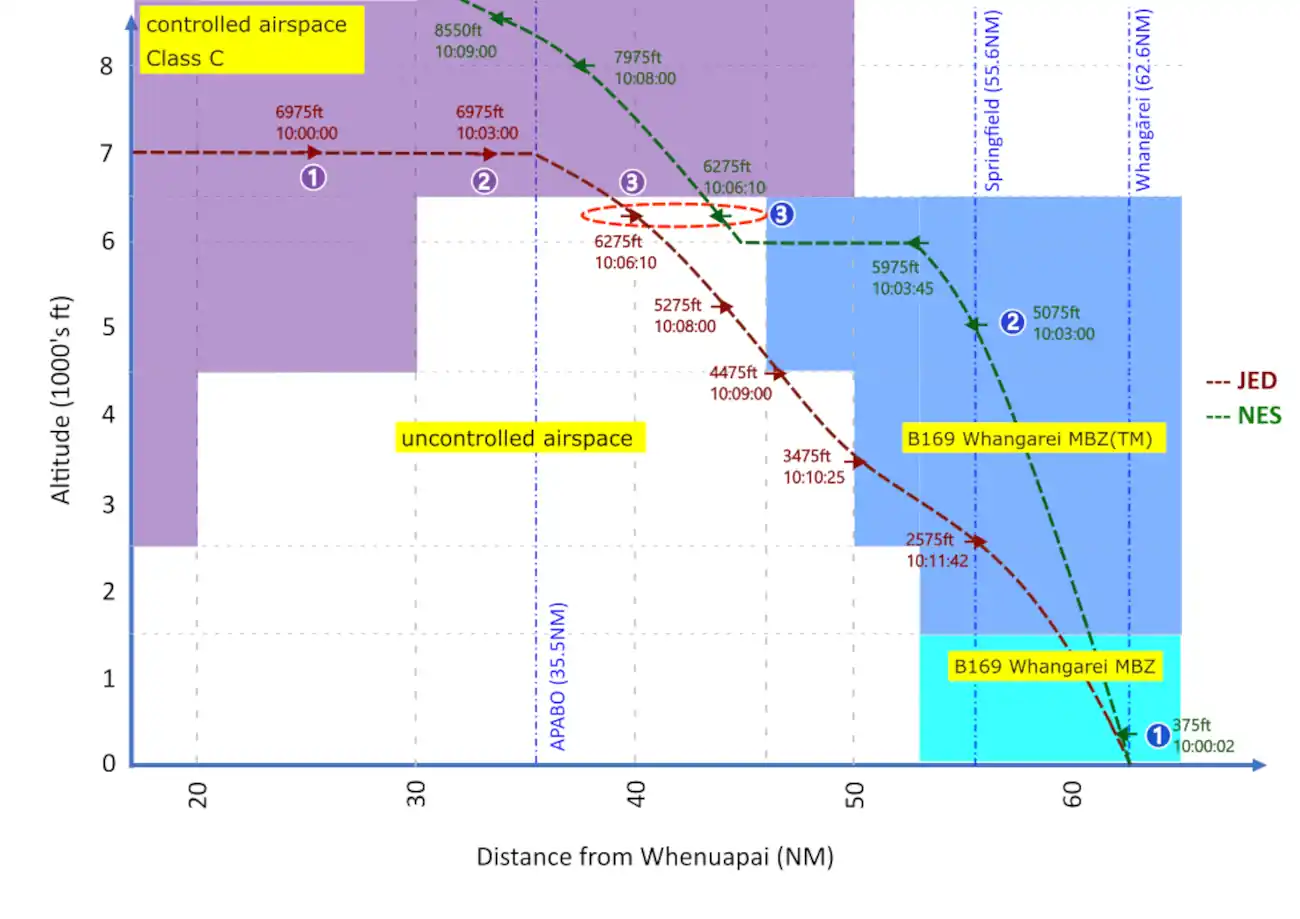
A Transport Accident Investigation Commission (TAIC) report has revealed that an Air New Zealand Q-300 and a training aircraft came within 41 seconds of a head-on collision over Northland in August 2023.
TAIC say the incident underscored long-standing systemic weaknesses in the country’s airspace management.
Both planes were directed into uncontrolled airspace—then a common workaround due to limited controlled zones—leaving pilots responsible for separation while flying in cloud, with only the Q-300 equipped with a collision-avoidance system.
TAIC found Whangārei’s airspace had not been reviewed since 2014 despite a requirement for five-yearly assessments, and no agency currently holds responsibility for overseeing nationwide reviews, leaving emerging risks unaddressed.
TAIC chief commissioner David Clarke said the incident involved “a southbound Air New Zealand Q300 and a northbound Beech Duchess” converging over the same 20-nautical-mile route segment above the Brynderwyn Hills.
He said both aircraft were instructed to pass each other in uncontrolled airspace, meaning pilots—“not air traffic controllers”—were responsible for avoiding a collision while relying on radio calls and limited traffic information.
The Q300 was flying in cloud at 6000 feet when the Beech descended through the same level, prompting the Q300’s ACAS to show a “conflict target”. Moments later, a Short-Term Conflict Alert triggered on radar, and the Q300 was cleared to climb.
Clarke said that although “nobody was hurt,” the aircraft passed just 4.3 nautical miles apart at a combined closing speed of 378 knots, calling it “too close” and the result of “insufficiently timely traffic information” and “long-standing weaknesses” in airspace design.
The Commission has urged the CAA to undertake an immediate review of Whangārei’s lower-level airspace and called on the Ministry of Transport to formally assign responsibility for ongoing nationwide airspace reviews to prevent future high-risk events.


Yes we could just as easily have been reading about a mid air collision with considerable loss of life
Its just an ordinary day until fate and human fallibility conspire at a critical point time to expose the failings and shortcomings prevalent in operating systems in operation at the time
Like what happened at Rakaia on the 11th of March 1899
Which was the end of the “she’ll be right” attitude on the railways