
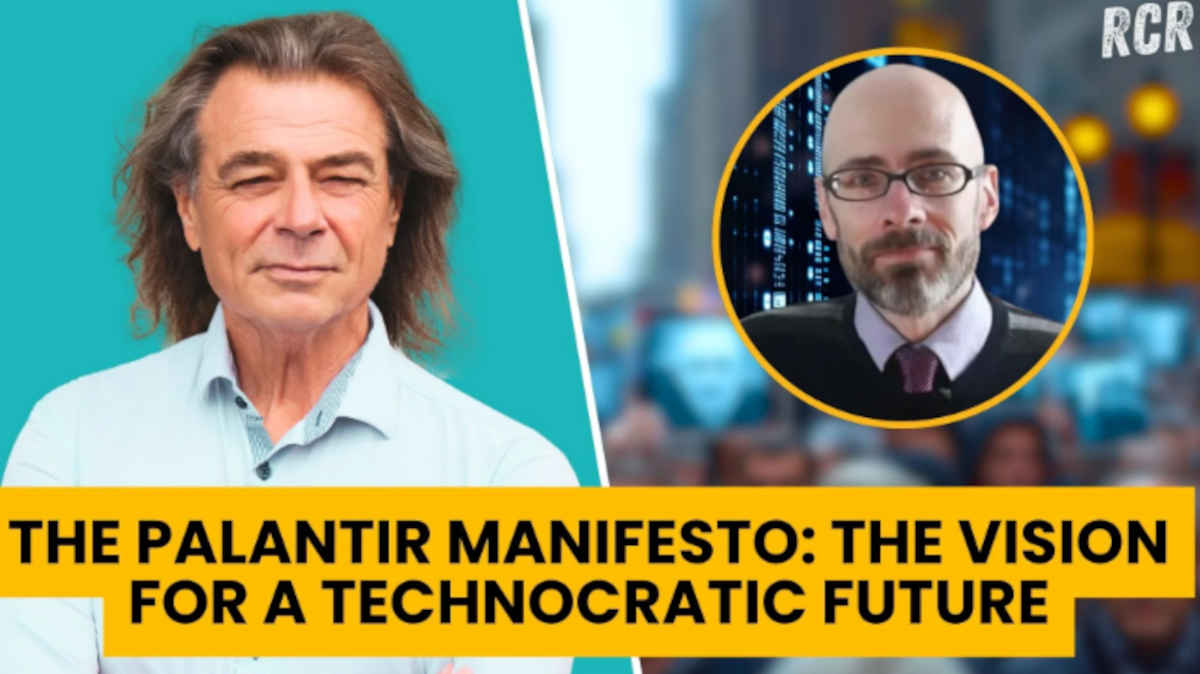
Palantir, controlled by billionaire Peter Thiel, has become increasingly influential in US government and intelligence circles.
Representing more than the rise of another technology company, it signals the emergence of a new model of governance in which data analytics and AI increasingly shape political and social decision-making.
That is the warning from investigative journalist and commentator James Corbett, who has been analysing The Technological Republic: Hard Power, Soft Belief, and the Future of the West, a manifesto co-authored by Palantir chief executive Alex Karp.
In the book, Karp argues that Silicon Valley has lost its sense of mission by focusing on consumer technologies and should instead renew its close partnership with defence and national security. He also openly advocates for technology companies to work hand-in-glove with state institutions in pursuit of broader geopolitical objectives.
Corbett contends that this approach treats inherently political questions as engineering problems that can be solved through data and algorithms. British journalist Carole Cadwalladr, who has investigated the company’s involvement in the UK, claimed that “Palantir is less a technology company than a political project,” based on statements made by Thiel.
Corbett raised concerns about Palantir’s technology for predictive policing and the expansion of surveillance systems capable of collecting vast amounts of personal data, from facial recognition and licence plate readers to online activity and location information. The opacity surrounding how such data is used poses significant risks to privacy and civil liberties, he said.
“Palantir is essentially a cutout for an intelligence agency office that was created and scrapped under the aegis of DARPA for surveilling and essentially database mapping everyone on the planet,” Corbett said.
Palantir’s global footprint is extensive and growing. In 2025, the company reported $1.855 billion in revenue from various US government contracts, while in the UK an investigation revealed 32 contracts worth at least £672 million across multiple central and local government agencies. In Australia, state and federal contracts with Palantir have reached nearly $80 million, and federal investment in the company is reportedly more than $160 million.
New Zealand’s relationship with Palantir stretches back at least to 2013 and involves both the NZ Defence Force and GCSB, but the number, value and scope of the company’s contracts remain undisclosed. Palantir also pitched its pandemic-tracking software to the Ministry of Health in 2020.
Corbett warns “Palantir, in a sense, is the forerunner of the new technocratic state that is coming into view”. Whether that future materialises would depend on how willing people are to surrender their data and autonomy in exchange for technological convenience” he said.
Watch RCR’s interview with James Corbett.
This story has been republished with permission from RCR Bites. For news like this direct and free to your Inbox every day, go to biteme.news to sign up for RCR Bites


And all those Kiwisaver providers boasting about their fund performances, guess what they’re heavily investing your money in?
Palantir, microsoft, spaceX and the others gathering and studying your data.
NZer’s (and Americans and others) paying for their own surveillance and control grid
Palantir will make the fake democracy uni-party political parties even more fake than they are now.
Who do the fake democracy uni-party political parties represent? Not the voters or citizens of the country.
“…the expansion of surveillance systems capable of collecting vast amounts of personal data, from facial recognition and licence plate readers to online activity and location information.”
Insidious and we can see why they want this vehicle tax to spy on n peoples vehicle usage and movements. National were also the party who gave Thiel NZ citizenship. That said, Labour are clearly also involved with given they were in office during COVID.
No trust=no vote. Steer clear of globalist party’s if you genuinely want a democratic future.