Observations from an Open Day visit to one of New Zealand’s highest-performing schools.
A visit to the Open Day at Diocesan School for Girls in Epsom — widely regarded as the top-performing girls’ school in New Zealand.
I attended the Open Day at Diocesan School for Girls in Epsom.
The campus immediately makes a strong impression: immaculate grounds, landscaped gardens, and buildings maintained to an exceptionally high standard. Everything speaks of care, investment, and pride.
The young women guiding visitors through the school were themselves beautifully presented — poised, courteous and confident.
No wonder parents and grandparents from many backgrounds hope their daughters might one day attend this school.
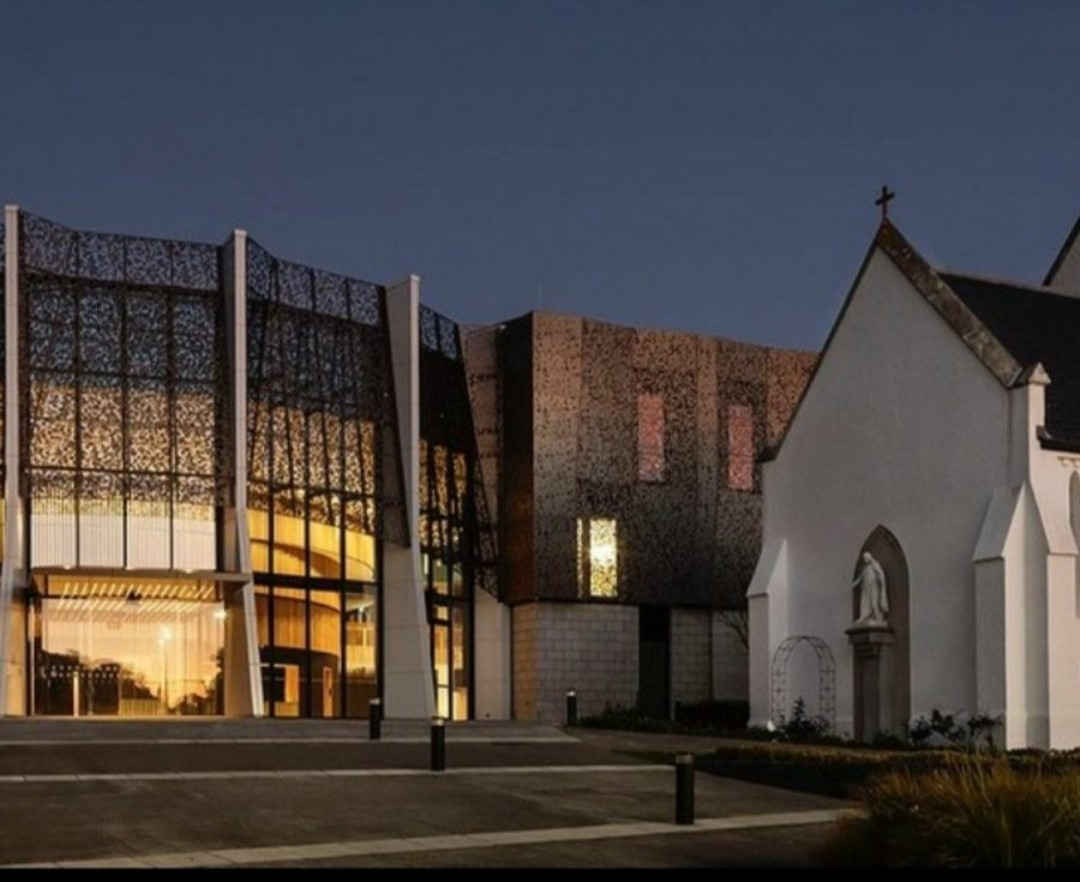
At the heart of the campus stands St Barnabas’ Chapel, with its white wooden exterior, dark shingle roof and a timber belfry nearby.
In front of the chapel stands a white statue of Jesus, surrounded by gardens.
Behind it sits the original School House, a large nineteenth-century timber villa built in the 1880s as the residence of the Anglican Bishop of Auckland and later becoming the first building of the school when it was founded in 1903.
Together these buildings reflect the English, European and Christian heritage from which the school grew.
This part of the campus even has its own resident character — Ollie, a black-and-white tabby cat who appears perfectly at home among the historic buildings.
Opening Talks in the Performing Arts Centre
The Open Day began in the Performing Arts Centre, where visitors — mostly parents and grandparents hoping to send their daughters to the school — gathered for the introductory presentation.
The speakers were Principal Heather McRae, Head of Senior School Margaret van Muilen, and the 2026 Head Girl, Ruby Walker.
As I listened, I was particularly attentive to certain words: Te Tiriti o Waitangi, tikanga Māori, Mātauranga Māori and Waiora. These themes were indeed mentioned. The school’s wellbeing programme, for example, is called Waiora.
The principal explained that the school gives effect to Te Tiriti o Waitangi, using the Māori wording Te Tiriti, and referred to guidance connected with UNDRIP.
During the presentation the following slide appeared.
The Dio Difference
- Ethics
- Leadership
- Identity
- Digital Creativity and Innovation
- Dio Shrub Record Label
- Enterprise and Entrepreneur Programme
- Mātauranga Māori
- But the real Dio Difference is you!
Another slide appeared.
Outstanding Achievements
In 2025 our NCEA results were outstanding.
Level 2
- 100% passed (71% national)
- 34% endorsed at Merit (25.5% national)
- 59.2% endorsed at Excellence (15.1% national)
Level 3
- 100% passed (66% national)
- 47% endorsed at Merit (26.6% national)
- 41% endorsed at Excellence (14.1% national)
A slide comparing independent schools across New Zealand showed Diocesan School for Girls achieving 31.4% Merit and 70.3% Excellence at NCEA Level 2, compared with 26% Merit and 15% Excellence nationally.
One thing I noticed, however, was that during the entire presentation — despite the school being an Anglican Christian school — the words Jesus, Christ, Christian, Anglican and even God were not mentioned.
The only visible reminder of the school’s religious character at that stage was the quiet presence of the school chaplain standing to one side.
The final speaker was Head Girl Ruby Walker, who began with her pepeha in fluent te reo Māori before continuing in English.
She spoke about the difference between fitting in and belonging with remarkable confidence and composure.
At seventeen years of age, I certainly could not have spoken to an auditorium full of hopeful parents, grandparents and their daughters with the same authority.
Ruby Walker is, we were told, a great-granddaughter of Ranginui Walker, the Māori scholar and commentator.
In Māori culture, ancestry and whakapapa are often acknowledged publicly and spoken of with pride.
That sits somewhat differently beside the ideals of a democratic society, where a person’s standing is usually understood to rest on her own achievements rather than those of her ancestors.
Ruby herself is clearly a high achiever. Yet she is also one among many.
The school reported that the 2025 graduating class received more than $2 million in university scholarships.
Guided Tour with Mira
After the presentations we were assigned a student guide — a Year 10 student whom I will call Mira to protect her identity.
Mira carried herself with poise and elegance and a maturity beyond her years.
Her blazer displayed a cluster of badges earned through school activities and service. She explained that the first badge could be earned through community service in Year 8, and that students could accumulate more over time through participation in different areas of school life.
She explained that the subjects are now called Food Tech, Digi-tech and Textile Tech. The old terms sewing and cooking are no longer in vogue.
During the tour she showed us the technology classrooms, the performing arts centre, the swimming complex, the sports stadium, the sports fields, the preschool and the junior school.
When we stepped into the art room, one detail stood out immediately: there was not a stray paint mark anywhere on the walls or floor.
Student work was carefully displayed for visitors.
As we walked, our conversation turned to identity.
Although she appeared Indian to me, Mira said she simply identified as a New Zealander.
Her family had been in New Zealand for more than a century, and her ancestry included Fijian, Indian, Singaporean, American and British heritage.
At one point I asked her directly whether the Head Girl is usually someone who identifies as Māori.
Mira replied that she had wondered the same thing herself.
She told me that four of the last five Head Girls had identified as Māori, while the fifth as Pasifika. Earlier, she said, the role had often gone to white girls.
She added that the Head Girl is usually chosen not only for academic achievement but also for broad participation across sport, the arts and leadership.
Listening to this, I could not help reflecting that the great majority of students at the school appear to be European or Asian.
Yet according to Mira, four of the last five Head Girls had identified as Māori and the fifth as Pasifika.
What I heard from Mira reflects a student’s perception.
But that perception itself is a sad indictment on the school.
Conversation with the Chaplain
After thanking Mira for the tour, we walked over to the chapel where the school chaplain was speaking with visitors.
Mira had introduced her simply as “Rev Rob”.
Her full name is the Reverend Sandy Robertson, the Anglican priest who serves as chaplain to the school.
During our conversation she mentioned that she is the “only remaining” female chaplain among Auckland’s independent Anglican schools.
The other schools — Dilworth and King’s College — currently have male chaplains.
She also explained that the chaplains from these schools attend St George’s Anglican Church in Epsom for Sunday worship.
Interestingly, she noted that at St George’s both wine and grape juice are offered for Holy Communion, whereas Anglican children have been receiving Communion wine for the past 500 years.
At the school itself, however, only the wafer is offered.
We also spoke about Matariki.
For the past four years the school community has gathered early in the morning on the summit of Mount Eden.
Students, staff and families attend together and say karakia addressed to one God, not to the nine Matariki atua.
The chaplain described the gathering as “big and popular”.
She described Matariki as a family event remembering those who have gone before us and marking the end of winter and the coming of spring.
She explained that while the Māori department teaches the stories of the nine Matariki atua, these are taught as cultural history rather than as religious practice.
How Diocesan School for Girls Gives Effect to Te Tiriti
From what I observed, three things appear clear.
Mātauranga Māori is taught for four consecutive years and includes Te Tiriti each year.
Social Studies is also taught for four consecutive years and includes Te Tiriti each year.
In other words, Te Tiriti appears in the curriculum eight times across four years. As Mira put it, by then the girls know it “off by heart” and, in her words, “it’s a bit much”.
In recent years the Head Girl positions have been held by students who identify as Māori or Pasifika in an all-girls school that is more than 99% European and Asian.
Go figure.
Postscript
After leaving the school I thought it would be sensible to check two things that came up during the tour: the recent Head Girls and the school’s ethnicity statistics.
The names publicly listed by the school are:
- 2026 — Ruby Walker
- 2025 — Lotosina Tavui
- 2024 — Edith Li
- 2023 — Aniva Clarke
- 2022 — Emma Parton
I also checked publicly available roll data for the school. According to the Education Review Office (ERO) review of Diocesan School for Girls in May 2021, the ethnic composition of the school roll was approximately 59% New Zealand European/Pākehā, 31% Asian, 0.5% Māori, and 0.2% Pacific.
References
- Education Review Office — Diocesan School for Girls
- Wikipedia — Diocesan School for Girls (Auckland)


More radical indoctrination.
Keep politics out of schools.