
New Zealand’s territorial waters, coastline and inland waterways have seen their fair share of maritime disasters over the past two centuries, ever since European vessels first began navigating the South Pacific.
The earliest recorded European shipwreck in New Zealand took place in 1795 when a sealing supply vessel named the Endeavour (not Captain Cook’s famous vessel) ran aground in Dusky Sound in Fiordland, marooning some 240 people ashore.
In regards to loss of life, the worst maritime disaster in New Zealand’s history was the loss of 189 crew members out of the 259 onboard during the sinking of the Royal Navy’s HMS Orpheus at the Manukau Heads in 1863.
And of course, every New Zealander is well aware of the diplomatic incident which resulted from the bombing of the Greenpeace vessel the Rainbow Warrior by the French secret service in the Auckland harbour in 1985.
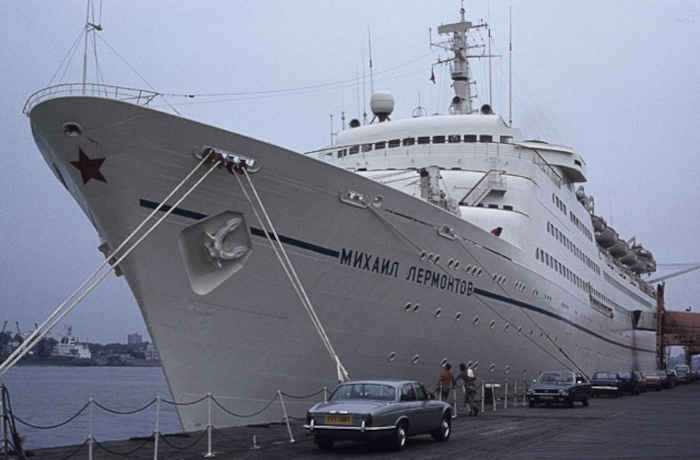
It was the sinking of the Soviet cruise liner the Mikhail Lermontov in the Marlborough Sounds in 1986 however, during the height of the Cold War at a time when the Labour Party Prime Minister David Lange was courting favour with the Kremlin, and just two years after he had compromised the American naval presence in the South Pacific by banning nuclear-powered ships in New Zealand waters, which is of under-rated significance in our maritime history.
The Mikhail Lermontov, which was launched in 1972, was the last of the ‘poet ships’, one of five ships named after famous Russian, Ukrainian and Georgian writers. She was originally used as an ocean liner, but was later upgraded in standards of comfort to suit Western taste and was employed as a cruise ship for international guests.
In February of 1986, she was voyaging on a pleasure cruise in New Zealand after departing from Sydney, carrying mostly elderly Australian passengers who were enticed by the novelty of travelling aboard a Soviet vessel and of enjoying a Russian cultural experience.
Departing from Picton at the top of the South Island that day, the ship was to explore the magnificent Marlborough Sounds, an intricate network of ancient valleys which were long ago swallowed by changing sea levels and a shifting landmass.
Given the shallow waters and submerged hazards of the area, the Marlborough Harbourmaster was aboard and was personally piloting the Mikhail Lermontov at the time of the incident, having already given assurances to her crew about his decision to navigate close to shore in order to better treat the passengers to the scenery.
It was at around half past five that the decision of the New Zealand maritime official onboard resulted in the ship tearing open her hull after making contact with rocks some five and a half metres below the waterline on her port side.
Although it was a warm summer’s evening when she ran into distress, darkness had set in by the time that passengers and crew began abandoning the vessel some three hours later, aided by local vessels attending the rescue. Another two hours later, and within twenty minutes of the last passenger being rescued, the ship had sunk beneath the surface of the water.
During the rescue, only one life was lost, that of thirty-three year-old engineer Pavel Zagladimov,
who was lost with the ship and whose body was never recovered. And since that time, several recreational divers have also died while exploring the wreck of the vessel, which lies between twelve and thirty-eight metres below the surface, on its starboard side.
On a personal note, in my childhood I was given a coin which was retrieved from the sunken wreck of the Mikhail Lermontov – my first authentic treasure.
And interestingly, historical footage taken during the aftermath of the incident even shows a diplomat resembling a younger Vladimir Putin, who was known to have been working for the KGB at the time of the incident, present in New Zealand as part of a Russian inquiry into the incident.
Although managed very carefully, the New Zealand authorities came to a similar conclusion during the official inquiry as those arrived at by the Soviet authorities – namely that Captain Don Jamison, the Marlborough harbourmaster and pilot who had been at the helm of the Mikhail Lermontov at the time, was responsible for the incident.
Despite this, the ship’s navigational officer Sergey Stepanishchev, was still sentenced by Soviet authorities for his role in not overriding the New Zealand harbourmaster. He received four years imprisonment, including labour, as well as fines equivalent to US $30,000.
Image credit: John Rostron, CC BY-SA 2.0.


Sabotage then.
Why are officials not prosecuted anymore?
The biggest mass-manslaughter in NZ history, even greater than the wars, goes not only unprosecuted but the villains are allowed to flee the counrty. Or even take up new political positions!