
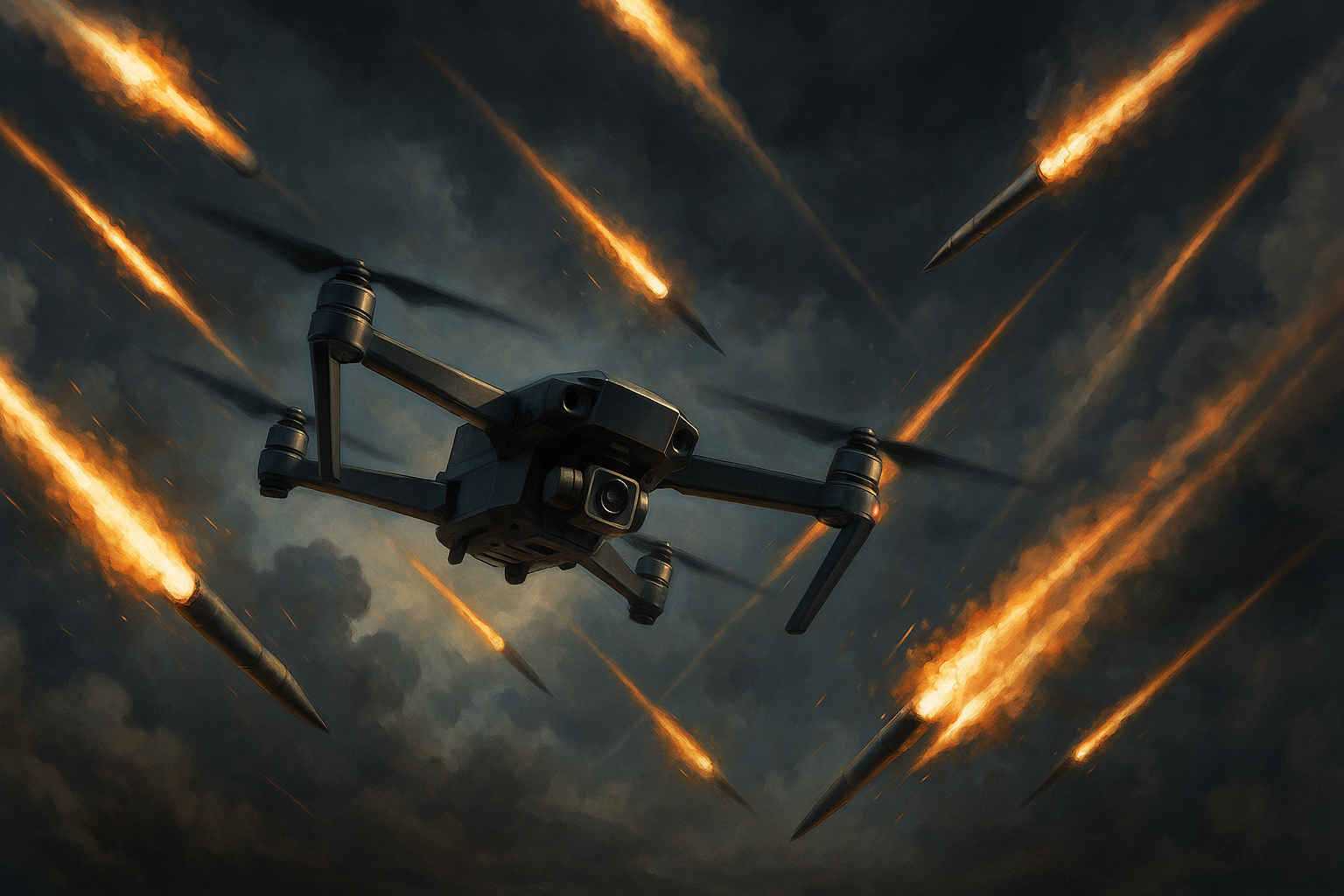
Western Europe’s leaders wave no-fly zone banners while America shrugs.
Why did a handful of foam plastic drones leave NATO in a panic? And why is Poland now proposing establishing a no-fly zone over Ukraine?
It has been a long time since the West entertained ideas as reckless as these. Polish Foreign Minister Radoslaw Sikorski broke what had been a useful tradition of keeping quiet when he suggested NATO should impose a no-fly zone. The last time we heard this nonsense was at the very start of the Russia-Ukraine conflict, when Vladimir Zelensky demanded that NATO shoot down every Russian missile and aircraft over Ukraine. Estonia cheered him on, but NATO leaders dismissed it. They knew then what should be obvious now: a no-fly zone would mean war with Russia. No one in the alliance dared risk it in 2022, and nothing has changed since.
So why bring it up again? Not because Warsaw has suddenly gone mad or discovered a taste for apocalypse. It is political theater, closer to the instincts of a porcupine fish puffing itself up than of a serious power. Poland – and much of Western Europe with it – is desperately trying to appear larger and scarier than it really is. The trigger was an incident in which a group of UAVs entered Polish airspace. Western European politicians seized on the episode, trying to extract maximum political mileage. But decisive action is the last thing on their minds.
The incident revealed just how unprepared NATO is for modern warfare. Nineteen unarmed, camera-less decoy drones crossed Polish skies. Their sole purpose was to commit “suicide” against air defenses before any real strike. NATO managed to shoot down only four. The rest wandered across Poland unhindered, some travelling nearly 500km before running out of fuel and falling from the sky.
In their panic, NATO scrambled F-35 fighters armed with AIM-9 Sidewinder missiles – each one costing $470,000. The price of a single decoy drone? No more than $3,000. To bring down a handful of foam contraptions worth $8,000-$12,000, NATO spent close to $1.9 million.
The alliance failed at every level. Intelligence failed because it did not detect the drones in time and then lost track of most of them. The military failed because it had no plan for such an obvious scenario. And political leaders failed because in almost four years of conflict they have done nothing to adapt NATO to the realities of 21st-century warfare. If this is how Poland and its partners cope with nineteen decoys, how do they plan to defend Ukraine from the drone swarms of a real battle?
The no-fly zone talk is also pointless without the United States. Washington commands the only truly powerful air force in NATO, yet it shows no interest in such schemes. The alliance is deeply divided. Its European members are demanding that America stop “flirting” with Moscow and impose harsher sanctions. Donald Trump, however, is digging in his heels, telling Brussels to impose measures themselves – and add tariffs against India and China while they are at it.
Even Trump, who rarely avoids hyperbole, did not join the hysteria. He limited himself to a post on social media and then suggested the drones may have strayed accidentally. That directly contradicted Warsaw’s alarmist claims.
The US also quietly declined to participate in Operation Eastern Sentry, a mission designed to protect NATO’s eastern flank. Forced to rely only on European resources, the operation ended up looking feeble and unconvincing.
So what can Western Europe do in this situation? Only what it always does: raise the alarm and toss out outlandish proposals. The more unrealistic the idea, the more it distracts from weakness. The main audience for this show is Russia – NATO wants to puff up its chest and project menace. But the second audience is closer to home.
Polish Prime Minister Donald Tusk admitted the real goal is to curb pro-Russian and anti-Ukrainian sentiment inside Western Europe. In 2022, Western leaders briefly managed to suppress their contradictions and present a united front. They want to revive that atmosphere now, even if it takes hysteria about drones and fantasies about no-fly zones.
Will it work? Probably not. Opinion campaigns are under way, but there are no serious polls yet to show whether Western Europeans are buying the story. My belief is that they will not. The mood of 2022 cannot be recreated. The talk of no-fly zones will end the same way as earlier attempts to whip up panic – with nothing.
By Vitaly Ryumshin, journalist and political analyst.


Just as planned. Logical too. More $$$ to MIC is the objective. So wasting million dollars really mean more $$$ diverted to MIC to replace the missiles. War is never cheap.
There is credible evidence that Russian drones operating in and around Poland have used SIM cards from Ukrainian mobile operators, as well as Polish and Lithuanian ones. This tactic is part of a broader strategy to exploit mobile networks for real-time data transmission, reconnaissance, and even flight corrections.
🛰️ How It Works
– Russian drones like the Shahed and Gerbera have been equipped with 4G modems and foreign SIM cards.
– These allow the UAVs to:
– Transmit video feeds and location data.
– Receive flight adjustments or intelligence updates.
– Monitor air defense activity via mobile signals.
🇵🇱 Polish Incidents
– On September 10, 2025, Russian drones violated Polish airspace in what officials called a “major provocation.”
– Wreckage from earlier drone incidents revealed Polish and Lithuanian SIM cards, suggesting Russia had been testing mobile connectivity across borders since July 2025.
– Some drones exploded near sensitive areas, including 40 km from a NATO base.
🇺🇦 Ukrainian SIMs
– Ukrainian officials confirmed that Russian drones have used Ukrainian SIM cards for months, especially in Shahed and Geran models.
– This prompted discussions about disabling mobile internet during air raids to disrupt drone communications.
🧭 Strategic Implications
– These incursions are not just tactical—they’re probing European defenses, mapping vulnerabilities, and testing response times.
– The use of foreign SIMs blurs attribution and complicates countermeasures.
Kiev false-flag provocation could lead to World War 3 – Zakharova
https://www.rt.com/russia/625345-ukraine-nato-provocation-ww3/
Ukraine is desperate
The beast is wounded
And dangerous
But predictable