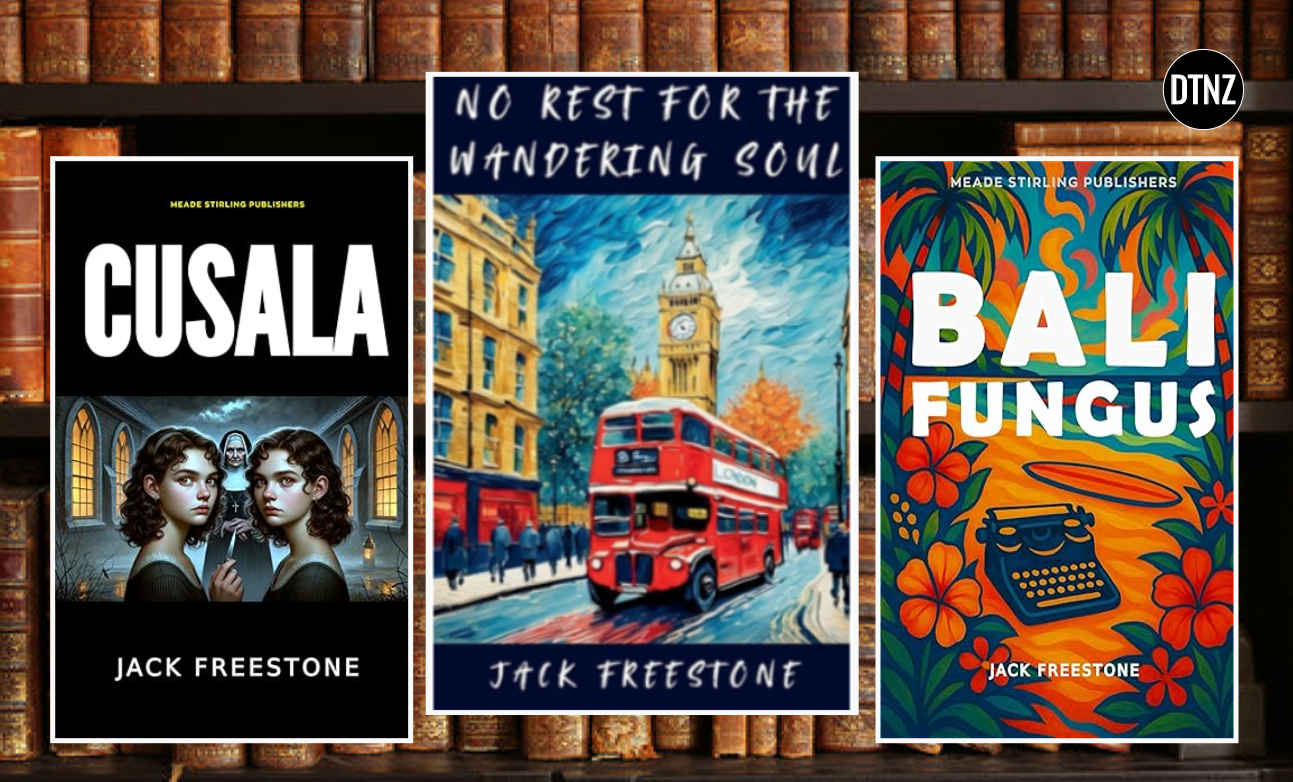
In this interview we catch up with New Zealand author Jack Freestone, who has recently returned home after some time abroad.
DTNZ: Welcome home, Jack!
JACK FREESTONE: Thanks, it is great to be back!
DTNZ: I know you like to travel. How long have you been away?
JACK FREESTONE: This time about seven years. That wasn’t planned, but I got caught in Munich when Convid broke out. I tried to leave Germany twice, a year apart, and both times my tickets were cancelled. In the end I just gave up trying. Luckily, I was staying with a friend and could teach online. It turned out well, as I ended up writing three books and a few short stories.
DTNZ: Nice. So, could you tell us something about your background?
JACK FREESTONE: Sure. I was born in England and grew up in Hampshire. My father was a pilot for the RAF in World War Two. He flew Lancaster bombers and received the Distinguished Flying Cross twice. He was just lucky and his plane was never hit badly and so he kept his crew safe throughout the entire war. He lost many of his friends though. Like most people who survived a war, he did not like to talk about the war much, though he did open up to me a bit more just before he passed away.
After the war he became a commercial pilot for BOAC. He flew VC10s. He and my mother had seven children. I am the youngest.
When he retired, my parents wanted to move overseas. They had two preferences, Cyprus and New Zealand. We loved both but, in the end, they chose New Zealand because in 1974 there was a war in Cyprus. I remember the checkpoints and the soldiers. Very exciting for an eight-year-old of course.
We ended up buying a twenty-five-acre hobby farm in Mangawhai. It truly was like arriving in paradise. We grew every type of fruit and vegetable imaginable plus we had masses of poultry, chickens, geese, and wild turkeys. Food wise, we were totally self-sufficient. The estuary was full of flounder which were easy to spear or net. My parents had large freezers full of food. Plus, we drank our water from a tank which collected rainwater. We made our own bread, butter, and even ice cream.
DTNZ: A great diet.
JACK FREESTONE: Yeah. I always loved creative writing. But when I got to university at Dunedin, I realised I would need to have a profession. Because at that time I really had nothing to write, except little stories. In the end, I chose law. I have no idea why, except that I liked the TV series The Paper Chase, and the play Twelve Angry Men. But as it turned out it was a good choice and I managed to pass all my law exams despite five years of partying. The other day I walked past where our flat used to be on Castle Street, and of course Selwyn College, which I also attended. Things looked the same except there was far more broken glass than in the eighties.
When I graduated, I really did not want to work as a lawyer.
I recall sitting at our dinner table at Mangawhai painfully trying to write a book that would earn me enough money to stop me being a lawyer. But not a word came. I was in tears. You see, I had nothing to write about. No real true-life experience.
Eventually, I got a job in a law firm. My novella, The Control Sickness, is based upon those experiences.
New Zealand was one of the few countries that did not have a proper bar exam as such. And so, I was only twenty-two, and I had to go to all courts except the Court of Appeal. To make matters worse, we had three of the most notorious judges in the country. As I wrote in The Control Sickness, the only way I got through those first harrowing two years was to pretend that I was an actor pretending to be a lawyer. The law degree gave me very little practical experience. When I arrived at my law firm, the secretaries knew far more than I did about procedure.
But, like anything, if you do it long enough you get good at it. And I became a very good lawyer, and barrister.
About seven years into my law career, I was in a duty solicitor team with a very bright and attractive young lawyer. I was infatuated with her, from a distance, of course. One day she wrote me a letter. She was a very good windsurfer, and I was a surfer. She was trying to sell me one of her three windsurfers as she was taking off overseas.
I remember clearly one sentence:
“There must be more to life than law.”
And I knew exactly what she meant.
A few years later I had a job interview in Nelson. It was a good job with a great salary, and I knew I pretty much had it in the bag. I had like half a day to kill and so I decided to drive to Kaikoura to see the surf. When I got there, the surf looked amazing. And it occurred to me that this was a pinnacle moment in my life. Did I want to be what would be considered ridiculously, insanely irresponsible, or did I want to do the responsible and boring thing and go to the interview? In the end, I chose to go surfing.
And that marks the beginning of my Great Escape series.
The sky did not fall on me. I felt very free and invigorated. Plus, I could write. I also fell quickly in love with a beautiful photographer and after a month or so we decided to go to Portugal.
It was like the Universe was rewarding me for being so brave. And of course it was my decision, and my life to live, and I was not harming anyone by it.
Yet one of my older brothers still will not speak to me to this day, because of that irresponsible decision to go surfing and not to the interview. He’s an accountant, haha, so perhaps it was to be expected.
And I have never looked back or regretted that decision.
Be brave and take risks and you will be rewarded.
DTNZ: You have written a total of nine books and two collections. But you have remained pretty much under the radar.
JACK FREESTONE: Yes, there are reasons for that which I will come to. But actually, I now see that as a blessing rather than a curse. There is nothing that makes a writer write more than being unread. And with each new work, you are trying to improve. Bukowski talked about that. How he was lucky in that regard and he wrote prolifically with most of his stuff being good. And how young writers and artists become spoiled when they achieve early success and fame.
This phenomenon was explained by Oscar Wilde who said something along the lines of we are all verbs, but most of us are verbs pretending to be nouns. Writers write. But when a writer achieves the objective label by society of “a writer” as in a noun, because they have gained enough money from it, they become restricted by their label.
They may say, “Oh my readers will not like that.” Therefore, money becomes the goal, and many artists sell out creatively in this regard.
The concept of the ego is better explained, I think, as the label we accept from society.
Virginia Woolf wrote, “I will not be famous, great. I will go on adventuring, changing, opening my mind and my eyes, refusing to be stamped and stereotyped. The thing is to free one’s self: to let it find its dimensions, not be impeded.”
But as far as why I have been unread, especially in New Zealand I think it has a lot to do with who runs the literary scene here, and also because my writing is not always considered “politically correct”. As I previously wrote on DTNZ a few years ago, all eight members of the national board of the New Zealand Society of Authors were female, at that time. Now it is six females and one male.
Obviously, this disproportionate representation affects male writers in New Zealand. As in, they are less likely to be supported by promotions, arts grants and so on, and are less likely to be published. The New Zealand Society of Authors refused to review and promote my novel, The Fake Celebrity in China because the female reviewer it was sent to disliked it.
Emerging New Zealand male writers may well need to go overseas to achieve success which I think is very sad.
However, they did put a couple of my books in the Hocken Library, so it is not all bad.
DTNZ: Do you read New Zealand writers? Who are some of your favourite authors?
JACK FREESTONE: For New Zealand writers I really liked One Night Out Stealing by Alan Duff. Janet Frame, of course. And more recently, Douglas Wright’s Ghost Dance was a great book.
I tend to read authors with a pleasant and natural writing style. In that regard, I like David Goodis and Somerset Maugham.
But my favourite book of all time would have to be, The Sun Also Rises by Hemingway. A truly magnificent book.
DTNZ: Thanks Jack, it’s been a fascinating discussion, as always.
JACK FREESTONE: My pleasure. Thanks for having me.
Jack Freestone’s latest novel, No Rest for the Wandering Soul, is now available at Meade Stirling Publishers.