A study led by Dr. Hyeon Seok Hwang from Kyung Hee University Medical Center in South Korea, published in Scientific Reports has identified a significant increase in reported cases of vaccine-associated kidney injuries.
Analysing over 120 million global adverse drug reaction reports from the WHO’s VigiBase, researchers found a disproportionate number of acute kidney injury (AKI), glomerulonephritis (GN), and tubulointerstitial nephritis (TIN) cases linked to COVID-19 mRNA vaccines.
The study suggests younger individuals, particularly adolescents aged 12–17, may face higher risks, raising concerns over vaccine safety monitoring.
While the findings highlight statistical associations rather than causation, researchers call for further investigation into potential immunological and genetic predispositions, pre-vaccination kidney screenings for high-risk individuals, and long-term safety surveillance.
Despite limitations such as reporting bias, the study underscores the need for continued pharmacovigilance and transparent public health discussions on vaccine-related risks.
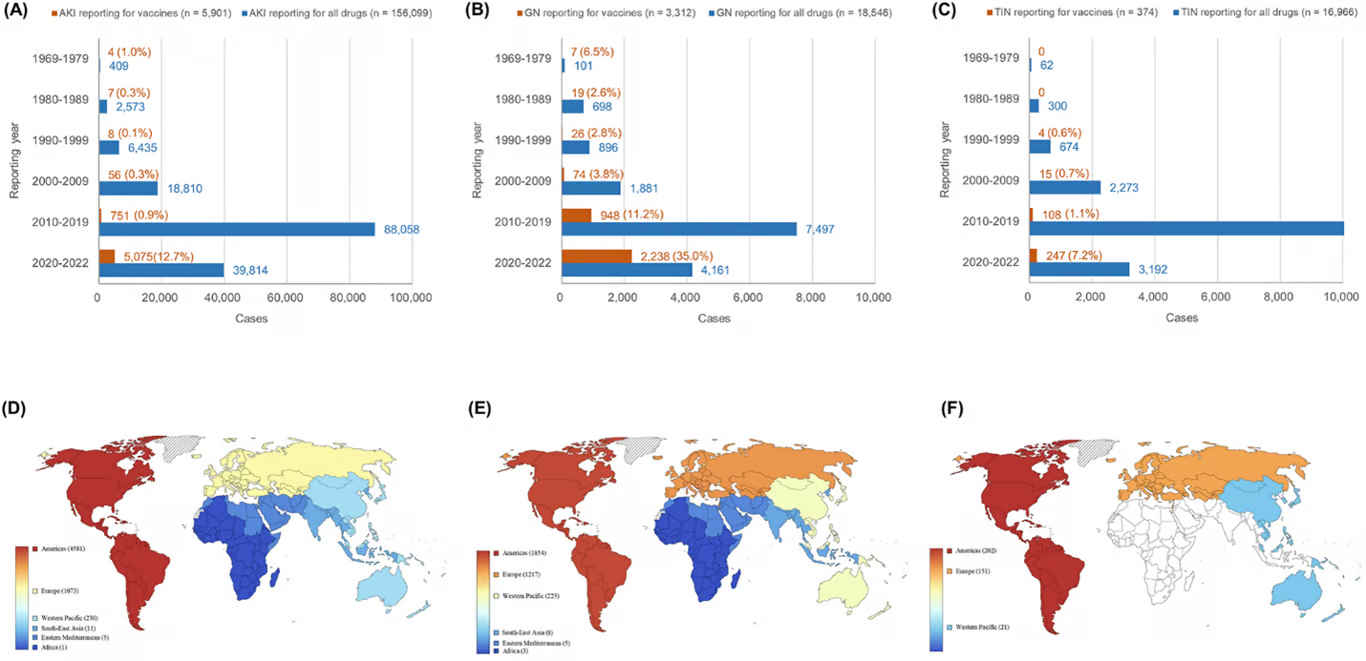
Temporal changes in the reported counts of vaccine- and drug-associated renal adverse events, and a world map showing reported cases across continents. The reported counts of AKI (A), GN (B), and TIN (C) are presented over timeframe. The number of each renal AE for vaccines (red bars) and all drugs (blue bars) is listed, and the proportions of renal AEs among all drug-related AEs are displayed as percentages adjacent to the red bars. Globally reported counts of AKI (D), GN (E), and TIN (F) are shown across continents. Regions with higher counts are indicated in red, while those with lower counts are marked in blue. AKI, acute kidney injury; GN, glomerulonephritis; TIN, tubulointerstitial nephritis. Image – Scientific Reports.
Support DTNZ
DTNZ is committed to bringing Kiwis independent, not-for-profit news. We're up against the vast resources of the legacy mainstream media. Help us in the battle against them by donating today.
No login required to comment. Name, email and web site fields are optional. Please keep comments respectful, civil and constructive. Moderation times can vary from a few minutes to a few hours. Comments may also be scanned periodically by Artificial Intelligence to eliminate trolls and spam.
This should not be difficult to prove / disprove in New Zealand.
Surely pre and post vaccination medical classifications aligned with pathological history held within patient records can provide unequivocal evidence.
New Zealand has electronic medical records and surely the data can be extracted with ease.
Surely Medsafe should focus on creating an initiative to extract the data and ensure adequate testing at a National level is being undertaken as part of their safety monitoring with a requirement to report appropriately.
This begs the question as to how accurately Medsafe (CARM) proactively report ALL vaccine adverse reactions and if not, why not? Relying on reported injuries does not mitigate the need for further research under urgency.
There is a narrow window of around 5 years left of patient record retention (10 years and 1 day since last consult) since 2020 and Medsafe should be using this time to determine safety, efficacy and probable adverse reactions to all medicines and vaccines.
Secondly, have they revised the groups of immunocompromised, immunosuppressive etc and their vaccines responses and newly diagnosed health conditions?
I would expect the answer is a categorical NO!



When will ardern and her cohorts face justice?
when the carnage is in everyone’s face and people rise up.
Our leaders will not do it.
Trump might.
Yale University has a “preprint” study implying c19 vax causing VAIDS in some populations.
This should not be difficult to prove / disprove in New Zealand.
Surely pre and post vaccination medical classifications aligned with pathological history held within patient records can provide unequivocal evidence.
New Zealand has electronic medical records and surely the data can be extracted with ease.
Surely Medsafe should focus on creating an initiative to extract the data and ensure adequate testing at a National level is being undertaken as part of their safety monitoring with a requirement to report appropriately.
This begs the question as to how accurately Medsafe (CARM) proactively report ALL vaccine adverse reactions and if not, why not? Relying on reported injuries does not mitigate the need for further research under urgency.
There is a narrow window of around 5 years left of patient record retention (10 years and 1 day since last consult) since 2020 and Medsafe should be using this time to determine safety, efficacy and probable adverse reactions to all medicines and vaccines.
Secondly, have they revised the groups of immunocompromised, immunosuppressive etc and their vaccines responses and newly diagnosed health conditions?
I would expect the answer is a categorical NO!