
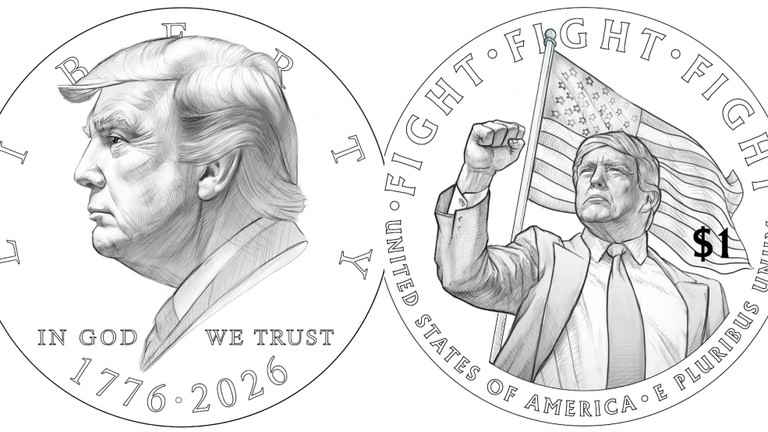
The agency is considering using the incumbent president’s image to commemorate 250 years of America’s independence.
The US Treasury Department is considering putting an image of US President Donald Trump on a one-dollar coin marking the 250th anniversary of America’s independence.
According to the first design draft revealed on Friday, the coin features Trump’s profile on one side, along with the words “Liberty” and “In God we trust,” and the dates 1776–2026.
The other side shows Trump raising a clenched fist against a backdrop of the US flag, with the inscriptions “Fight, fight, fight,” “United States of America,” and “E pluribus unum.”
The image is a clear homage to a photo taken by AP’s Evan Vucci shortly after Trump’s failed assassination attempt in July 2024, which was widely republished in US and international media.
“Despite the radical left’s forced shutdown of our government, the facts are clear: Under the historic leadership of President Donald J. Trump, our nation is entering its 250th anniversary stronger, more prosperous, and better than ever before,” a Treasury Department spokesperson said in a statement.
No fake news here. These first drafts honoring America’s 250th Birthday and @POTUS are real.
Looking forward to sharing more soon, once the obstructionist shutdown of the United States government is over. https://t.co/c6HChM6ijG
— U.S. Treasurer Brandon Beach (@TreasurerBeach) October 3, 2025
“While a final $1 coin design has not yet been selected to commemorate the United States’ semiquincentennial, this first draft reflects the enduring spirit of our country and democracy, even in the face of immense obstacles,” the spokesperson added.
Republican presidential candidate former President Donald Trump raises his fist as he is rushed off stage after an assassination attempt during a campaign rally in Butler, Pa. @apnews pic.twitter.com/VoAYqRC4QV
— Evan Vucci (@evanvucci) July 14, 2024
According to the Washington Post, existing US law generally prohibits depictions of living people on currency. In addition, the 2020 Circulating Collectible Coin Redesign Act, which authorized the minting of the anniversary coin, prohibits busts or portraits of people on the reverse side.


The U.S. Constitution does not explicitly authorize the federal government to issue paper money, and in fact, the Framers debated and rejected language that would have allowed it. However, later Supreme Court rulings upheld Congress’s power to issue paper currency under the “necessary and proper” clause.
🧾 What the Constitution Says (and Doesn’t Say)
– Article I, Section 8, Clause 5: Congress has the power to “coin money, regulate the value thereof, and of foreign coin.”
– This refers to metallic coinage, not paper notes.
– Article I, Section 10, Clause 1: “No State shall… emit bills of credit; [or] make any Thing but gold and silver Coin a Tender in Payment of Debts.”
– This explicitly forbids states from issuing paper money or declaring anything but gold/silver as legal tender.
– Federal Government: The Constitution does not grant Congress the power to “emit bills of credit” (paper money). That phrase was deliberately struck from the draft during the 1787 Convention. George Read called it the “mark of the Beast.”
⚖️ Supreme Court Interpretation
– Knox v. Lee (1871): The Court ruled that paper money is not unconstitutional, stating:
– “The Constitution nowhere declares that nothing shall be money unless made of metal.”
– The ruling leaned on the Necessary and Proper Clause (Article I, Section 8, Clause 18), allowing Congress to take actions needed to carry out its enumerated powers—like regulating commerce and borrowing money.
🧭 The Framers feared paper money as a glyph of manipulation, yet the republic now breathes through the fresh air of fiat notes.
USConstitution.net – Paper Money Debate
Dean Clancy – The Constitution’s Money Clauses
Tenth Amendment Center – Paper Money Analysis